Let me tell you about a map that doesn’t look like any map you’ve ever seen.
It’s round. The world is a perfect circle, surrounded by a ring of ocean that loops back on itself. The landmass is mostly empty space, with a few jagged lines suggesting mountains and wiggly strokes indicating rivers. Arabia floats near the center, recognizable only because the Red Sea splits it from Africa. There are no latitude lines, no longitude grids, no coastlines you’d actually recognize. South is at the top. Mecca glows at the heart of everything. And if you didn’t know what you were looking at, you’d probably guess it was some kind of abstract art rather than a serious attempt to represent the world.
This is the world map from the “Book of Roads and Kingdoms” (Kitāb al-Masālik wa’l-Mamālik), copied in 1193 CE and now housed at Leiden University Libraries . It belongs to a tradition of Islamic cartography that flourished for over a thousand years, producing thousands of maps scattered across manuscripts from Spain to China. These maps don’t look like modern maps. They don’t follow the conventions we’ve absorbed from Google Earth and classroom wall charts. They don’t even follow the conventions of contemporary European maps, with their coastlines and place-names and growing accuracy.
And that’s exactly what makes them so fascinating.
For a long time, Western scholars dismissed Islamic maps as primitive or derivative. They compared them unfavorably to the precise Ptolemaic projections of Renaissance Europe and found them wanting. But that judgment missed the point entirely. Islamic maps weren’t trying to do what European maps were doing. They had different purposes, different audiences, different ways of understanding what a map should be.
At The Islamic Manuscripts Press of Leiden (IMPL), we believe that understanding Islamic cartography means setting aside our assumptions about what maps are “supposed” to look like. It means entering a world where maps could be geometric abstractions, theological statements, political arguments, or tools for finding God. It means meeting the map-makers themselves—al-Khwārazmī, al-Iṣṭakhrī, al-Idrīsī, and countless others—and asking what they were trying to do.
So grab a compass (the metaphorical kind), orient yourself to a world where south might be up, and let’s explore the rich tradition of geography and cartography in Islamic manuscripts.
The Big Picture: What Survives and Why It Matters
Before we dive into specific maps and map-makers, let’s get our bearings. How many Islamic maps survive? What kinds of manuscripts contain them? And why should we care?
The answers are complicated, but here’s what we know. Hundreds of exceptional cartographic images are scattered throughout medieval and early modern Arabic, Persian, and Turkish manuscript collections . The plethora of copies created around the Islamic world over the course of eight centuries testifies to the enduring importance of these medieval visions for the Muslim cartographic imagination .
Some of the most important manuscripts are held in European libraries, acquired over centuries by collectors, diplomats, and scholars. The Gotha Research Library in Germany, for example, holds a copy of al-Iṣṭakhrī’s “Book of Roads and Kingdoms” that was declared UNESCO World Documentary Heritage in 2015 . This manuscript, dated to 1173 CE, contains 21 maps of the Islamic world and is one of the oldest surviving examples of its kind.
Leiden University Libraries holds another crucial manuscript: a world map from a summary of al-Iṣṭakhrī’s work, catalogued as MS Or. 3101 and dated to 1193 . This is the map I described at the beginning—round, schematic, with south at the top and Mecca near the center.
The University of Michigan’s Islamic Manuscripts Collection, one of the largest in North America, contains numerous geographical texts, including works on “the Qur’an and sciences, collections and studies in the science of ḥadīth, and works of theology, jurisprudence, Sufism, philosophy, mathematics, astronomy, rhetoric, grammar, poetry, belles-lettres, history, geography, and medicine” . Geography was integrated into a broader intellectual culture, not isolated as a separate discipline.
Yossef Rapoport’s 2020 book “Islamic Maps” tells the story of the key Muslim map-makers and the art of Islamic cartography, spanning from ninth-century Baghdad to nineteenth-century Iran . Rapoport shows that Muslim map-makers, including al-Khwārazmī and al-Idrīsī, combined novel cartographical techniques with art, science and geographical knowledge. The results could be aesthetically stunning and mathematically sophisticated, politically charged as well as a celebration of human diversity .
The maps constructed by Muslim map-makers capture the many dimensions of Islamic civilisation, providing a window into the worldviews of Islamic societies . They show us not just where places were, but what they meant—how people understood their world, their place in it, and their relationship to God.
The Classical Tradition: The Balkhī School and the Atlas of Islam
Let’s start with the most influential tradition in Islamic cartography: the Balkhī School, also known as the Classical School of Islamic mapmaking.
Who Were the Balkhī School?
The Balkhī School was a group of four Muslim geographers who worked in the 10th century CE, drawing on the earlier work of Abū Zayd al-Balkhī (d. 934 CE) . The key figures were:
- Abū Zayd al-Balkhī, whose original work Ṣuwar al-Aqālīm (Images of the Climes) is now lost but survives through the works of his followers .
- Al-Iṣṭakhrī (d. 951 CE), who wrote the Kitāb al-Masālik wa’l-Mamālik (Book of Roads and Kingdoms) in the first half of the 10th century . His work became the foundation for the entire tradition.
- Ibn Ḥawqal, who revised al-Iṣṭakhrī’s work and produced his own Ṣūrat al-Arḍ (The Face of the Earth) around 988 CE .
- Al-Muqaddasī, who wrote Aḥsan al-Taqāsīm fī Maʿrifat al-Aqālīm (The Best Divisions for Knowledge of the Climes) and is often considered the greatest of the four.
These geographers developed a distinctive style of mapmaking that would be copied and adapted for centuries. Their works are sometimes called the “Atlas of Islam” because they focus on the Islamic world and its regions .
What Made Their Maps Unique?
The maps of the Balkhī School are immediately recognizable. They’re schematic rather than realistic, using geometric shapes to represent geographical features. A map of the Mediterranean might show the sea as a rectangle with a few curves, the coastline as a series of straight lines and right angles. A map of a province might show cities as circles, rivers as parallel lines, mountains as jagged teeth.
These maps don’t try to represent the physical world as it actually appears. As the Andalusī scholar Abū Bakr Zuhrī explained: “Their objective is the depiction of the earth, even if it does not correspond to reality. Because the earth is spherical but the [map] is simple” .
In other words, the mapmakers knew the earth was round. They weren’t ignorant of spherical geometry or Ptolemaic projections. They simply chose to represent the world in a different way—one that emphasized relationships, routes, and regions over exact coastlines and distances.
The Balkhī maps typically include:
- A world map, round and surrounded by the Encircling Ocean (the “Baḥr al-Muḥīṭ”)
- Three maps of seas: the Mediterranean, the Indian Ocean, and the Caspian Sea
- Seventeen regional maps covering the Islamic world from Morocco to Central Asia
The regional maps follow a consistent pattern. Each shows a province or region, with its cities, rivers, and mountains. The Arabian Peninsula, for example, appears with Mecca and Medina marked, the Red Sea on one side, the Persian Gulf on the other. The maps are oriented with south at the top—a convention that can confuse modern viewers but was standard in this tradition.
The Conceptual Framework
The Balkhī geographers adopted the Greek model of the seven climes (regions based on latitude) but expanded it to include Persian or Indian concepts of dividing the world . They were interested in what historian Zayde Antrim calls the “discourse of place”—a literary and scholarly tradition that both describes the land and gives it literary and spiritual meaning .
For the Balkhī geographers, a map was not just a tool for navigation. It was a way of organizing knowledge, of understanding the relationship between regions, of placing the Islamic world at the center of human civilization. Their maps are arguments about what matters, not just representations of what exists.
The UNESCO World Documentary Heritage Manuscript
One of the most important surviving copies of the Balkhī tradition is held at the Gotha Research Library in Germany. This manuscript, copied in 1173 CE, contains 21 maps: a world map, three sea maps, and 17 regional maps covering present-day Morocco, Egypt, Syria, Iraq, Persian provinces, Armenia, Azerbaijan, and Transoxania .
The manuscript was acquired in 1807 by the explorer Ulrich Jasper Seetzen in Cairo, acting on behalf of his patrons, the Dukes of Saxe-Gotha-Altenburg . In October 2015, it was declared UNESCO World Documentary Heritage as part of the Memory of the World programme, recognizing its exceptional cultural significance .
The manuscript’s inclusion in the UNESCO register reflects its importance as a record of tenth-century Islamic geography and cartography. It provides “worldwide access to this culturally significant and historically important document” and preserves it “from being forgotten and destroyed” .
The Book of Curiosities: A Mysterious Masterpiece
Not all Islamic maps fit the Balkhī mold. One of the most extraordinary examples is the “Book of Curiosities” (Kitāb Gharāʾib al-Funūn wa-Mulaḥ al-ʿUyūn), a unique manuscript discovered in the Bodleian Library in Oxford in 2000.
What Is the Book of Curiosities?
The Book of Curiosities is an anonymous Arabic cosmography composed in Egypt around 1020-1050 CE. It’s a compendium of knowledge about the heavens and the earth, with chapters on astronomy, astrology, geography, and marvels. What makes it extraordinary is its illustrations: over 30 diagrams and maps, many of which have no parallel in any other known manuscript.
Yossef Rapoport devotes a chapter of “Islamic Maps” to what he calls “The mysterious Book of curiosities” . The maps include:
- A rectangular world map, unlike the round maps of the Balkhī tradition
- Detailed maps of the Nile River, showing its sources in the Mountains of the Moon
- Maps of the Mediterranean, with islands labeled and coastlines indicated
- A map of the Indian Ocean, showing the route to Southeast Asia
- Diagrams of harbors and coastal features
These maps are more detailed and more varied than anything in the Balkhī tradition. They suggest a different kind of cartography, perhaps drawing on nautical sources or administrative documents. The map of the Nile, for example, shows the river’s course from its sources in equatorial Africa to its delta in Egypt, with cities, tributaries, and even the pyramids marked.
What the Maps Reveal
The Book of Curiosities maps reveal a sophisticated understanding of geography and a willingness to experiment with different forms of representation. The rectangular world map, with its grid-like structure, recalls the Ptolemaic tradition while adapting it to Islamic purposes. The Indian Ocean map shows detailed knowledge of the monsoon routes that connected the Middle East to India and Southeast Asia.
The maps also reveal the political and religious concerns of their creator. The Nile map emphasizes Egypt’s centrality to the Islamic world. The Mediterranean maps highlight the islands and ports that were contested between Muslim and Christian powers. The Indian Ocean maps celebrate the reach of Muslim traders and travelers.
The Book of Curiosities is a reminder that Islamic cartography was not a single, monolithic tradition. Different mapmakers working in different contexts produced different kinds of maps for different purposes. The Balkhī tradition was influential, but it was not the only game in town.
Al-Idrīsī and the Royal Geographic
No exploration of Islamic cartography would be complete without al-Idrīsī, perhaps the most famous Muslim mapmaker of all. His work represents a different approach entirely—one commissioned by a Christian king and drawing on both Islamic and European sources.
The Man and His Patron
Abū ʿAbd Allāh Muḥammad al-Idrīsī was born in Ceuta, North Africa, around 1100 CE. He was educated in Córdoba, the great center of Islamic learning in Spain, and traveled widely throughout the Mediterranean world. Around 1138, he entered the service of Roger II, the Norman king of Sicily—a remarkable patron who surrounded himself with scholars from multiple cultures and religions.
Roger commissioned al-Idrīsī to create a new and accurate map of the world. The result, completed around 1154, was a massive silver planisphere and a accompanying geographical text known as the Kitāb Rujār (The Book of Roger) or, more formally, Nuzhat al-Mushtāq fī Ikhtirāq al-Āfāq (The Delight of Him Who Longs to Cross the Horizons).
The Map and Its Innovations
Al-Idrīsī’s world map was fundamentally different from the Balkhī tradition. It was oriented with north at the top, following Ptolemaic conventions. It divided the world into seven climes (latitudinal zones) and ten longitudinal sections, creating a grid of 70 regions. For each region, al-Idrīsī provided detailed descriptions and maps.
The map incorporated information from multiple sources: Islamic geographical traditions, accounts of travelers and merchants, and European sources available in Sicily’s multicultural court. It extended from Spain to China, from Scandinavia to the sources of the Nile. It showed the Volga River, the Baltic Sea, and the lands of the Rus’. It depicted the Himalayas and the mountains of Central Asia.
Rapoport calls this “The grid of al-Sharīf al Idrīsī” , highlighting the systematic, almost scientific approach that al-Idrīsī brought to his work. The grid allowed users to locate places with reasonable accuracy and to understand their relationship to the broader world.
The Legacy
Al-Idrīsī’s work was immensely influential. Copies circulated throughout the Islamic world and later reached Europe, where they influenced Renaissance cartography. The original silver planisphere was destroyed in a rebellion shortly after Roger’s death, but manuscript copies of the text and its maps survive in libraries around the world.
Al-Idrīsī’s map represents a high point of Islamic cartography—a synthesis of Greek, Islamic, and European knowledge, produced at the intersection of cultures and underwritten by royal patronage. It shows what was possible when a skilled geographer had the resources and support to pursue his vision.
The Ottoman Contribution: Expanding Horizons
The Ottoman Empire, which ruled from the late 13th century until 1922, produced its own distinctive cartographic tradition. Ottoman mapmakers built on earlier Islamic work while incorporating new information from European sources and their own extensive networks.
The Expanding Horizons of an Ottoman Admiral
Rapoport’s “Islamic Maps” includes a chapter on “The expanding horizons of an Ottoman Admiral” . This refers to Piri Reis, the Ottoman admiral and cartographer who produced his famous world map in 1513. The surviving fragment shows the Atlantic coastlines of Europe, Africa, and South and Central America, including the first detailed Ottoman map of the Caribbean.
Piri Reis compiled his map from multiple sources: Islamic maps, Portuguese charts, and even a map supposedly drawn by Columbus himself. His Kitāb-i Baḥrīye (Book of Navigation) includes detailed charts of the Mediterranean, with port cities, coastal features, and navigational information.
What’s remarkable about Piri Reis is his willingness to combine information from different traditions. He recognized the value of European nautical charts and incorporated them into his work. He was also a skilled navigator who could supplement book learning with practical experience.
Ottoman Regional Mapping
The Ottomans also produced numerous regional maps of their vast empire. These maps served administrative, military, and fiscal purposes. They showed provinces, cities, and routes. They were often highly detailed and practically oriented.
The University of Michigan’s Islamic Manuscripts Collection includes Ottoman manuscripts with “exquisite calligraphic specimens by Ottoman masters” as well as “four albums containing 158 calligraphic specimens” . While these are primarily calligraphic rather than cartographic, they show the same attention to detail and aesthetic refinement that characterized Ottoman mapmaking.
The Enduring Balkhī Tradition
Even as Ottoman cartographers experimented with new forms, the older Balkhī tradition continued to be copied and studied. Karen Pinto’s “Medieval Islamic Maps” traces the transmission of the Balkhī maps through the Ottoman period, showing how they remained relevant for centuries .
Pinto identifies an “Ottoman cluster” of manuscripts that preserve and adapt the Balkhī tradition . These manuscripts show that the old maps were not simply museum pieces—they were living documents, copied and used by new generations of readers.
The Purpose of Maps: Why Make Them?
Now that we’ve surveyed the major traditions, let’s step back and ask a fundamental question: why did people in the Islamic world make maps? What purposes did they serve?
Finding the Qibla
One of the most important practical purposes of Islamic cartography was finding the qibla—the direction of prayer toward Mecca. Every Muslim, wherever they are in the world, needs to know which way to face when performing their daily prayers. This is a geographical problem, and mapmakers addressed it.
Rapoport’s “Islamic Maps” includes a chapter on “An astrolabe for a Shah, or finding the direction of Mecca in Safavid Isfahan” . This shows how sophisticated instruments and calculations could be used to determine the qibla with great accuracy.
A 2025 study in the International Journal of Engineering & Geosciences addresses the qibla direction problem in large-scale maps, developing an interface to calculate the qibla with geodetic accuracy for all maps in Türkiye’s national mapping system . The authors note that “In Islamic societies, knowing the direction of the Qibla is important in the planning of religious areas” .
The qibla problem connects cartography to the most fundamental religious obligations. It shows that Islamic mapmaking was not just an academic exercise—it had real, practical consequences for how people lived their faith.
Administering Empires
Another important purpose was administration. The “Books of Roads and Kingdoms” emerged from the administrative tradition of listing pilgrim and post stages . They were practical guides for officials who needed to know the distances between cities, the routes that connected them, and the peoples who lived along the way.
Ibn Khordadbeh, who wrote the earliest surviving version of the Book of Roads and Kingdoms around 870 CE, was himself a postal official in the Abbasid administration . His work reflects the needs of a vast empire that required reliable information about its territories.
The Balkhī maps, with their regional organization, served a similar purpose. They provided officials with a visual overview of the provinces they governed. They showed the relationships between cities, the courses of rivers, the positions of mountains. They were tools of statecraft as much as works of scholarship.
Understanding the World
A third purpose was simply understanding. Islamic scholars were deeply curious about the world and its peoples. They wanted to know where places were, how they related to each other, and what made them distinctive.
The geographical literature that emerged from the Balkhī tradition combined maps with detailed descriptions. Al-Iṣṭakhrī’s work included not just maps but also information about “climatic peculiarities and information about cities, trade, customs and language” . The maps and the text worked together to create a comprehensive picture of the Islamic world.
This tradition of geographical writing is what historian Zayde Antrim calls the “discourse of place”—a literary tradition that gives the land meaning through description . The maps were part of this discourse, visual complements to the textual evocation of place.
Asserting Power and Piety
Finally, maps could serve political and religious purposes. The Balkhī maps, with their focus on the Islamic world, assert the centrality of Islam to human civilization. The world map places Arabia near the center; the regional maps focus on the lands ruled by Muslims.
Karen Pinto’s “Medieval Islamic Maps” explores this dimension in depth. She examines how the maps’ treatment of the Encircling Ocean, the Beja people of East Africa, and other features reflects cultural and political assumptions . The maps are not neutral—they’re arguments about how the world is and should be.
Ottoman maps, too, served political purposes. They asserted Ottoman claims to territory, celebrated Ottoman victories, and projected Ottoman power. A map of the Mediterranean might highlight Ottoman ports and downplay Christian ones. A map of a province might emphasize its resources and its loyalty to the sultan.
The Aesthetics of Islamic Maps: Art and Science Combined
One of the most striking features of Islamic maps is their beauty. These are not dry, functional documents—they’re works of art, with careful attention to color, composition, and calligraphy.
Geometric Patterns
The Balkhī maps are deeply geometric. The world is a circle. The seas are rectangles. The coastlines are composed of straight lines and right angles. This is not a failure of realism—it’s a deliberate aesthetic choice, rooted in the broader Islamic tradition of geometric ornament.
Rapoport notes that Muslim map-makers “developed distinctive styles, often based on geometrical patterns and calligraphy” . The maps share visual vocabulary with contemporary manuscript illumination, architectural decoration, and textile design.
The geometry serves multiple purposes. It makes the maps visually coherent and aesthetically pleasing. It emphasizes order and regularity—the world as a rational, comprehensible place. And it connects the maps to broader traditions of Islamic art, integrating geography into the visual culture of Islamic civilization.
Color and Decoration
Color plays an important role in Islamic maps. Seas might be blue or green. Rivers might be blue lines. Mountains might be brown or red. Cities might be marked with colored circles or rosettes.
The Gotha manuscript of al-Iṣṭakhrī’s work includes maps with “beautifully illuminated headpieces” and careful coloring . The Leiden manuscript’s world map uses red for some features, black for others, creating visual hierarchy and emphasis.
These colors are not just decorative—they’re informative. They help viewers distinguish different features, follow routes, and understand relationships. But they’re also beautiful. The mapmakers wanted their work to be a pleasure to look at, not just a tool to use.
Calligraphy
Calligraphy, the highest art form in Islamic civilization, also appears on maps. Place names are written in elegant scripts, carefully placed and beautifully formed. The same attention that went into copying a Qur’an went into labeling a map.
The calligraphy on maps serves multiple purposes. It identifies places, obviously. But it also integrates the maps into the broader manuscript culture. A map in a geographical manuscript is part of a larger book, and its calligraphy connects it visually to the text that surrounds it.
The University of Michigan’s collection includes “exquisite calligraphic specimens” by Ottoman masters . While these are separate from maps, they show the same attention to beautiful writing that characterizes cartographic calligraphy.
The Map as Object
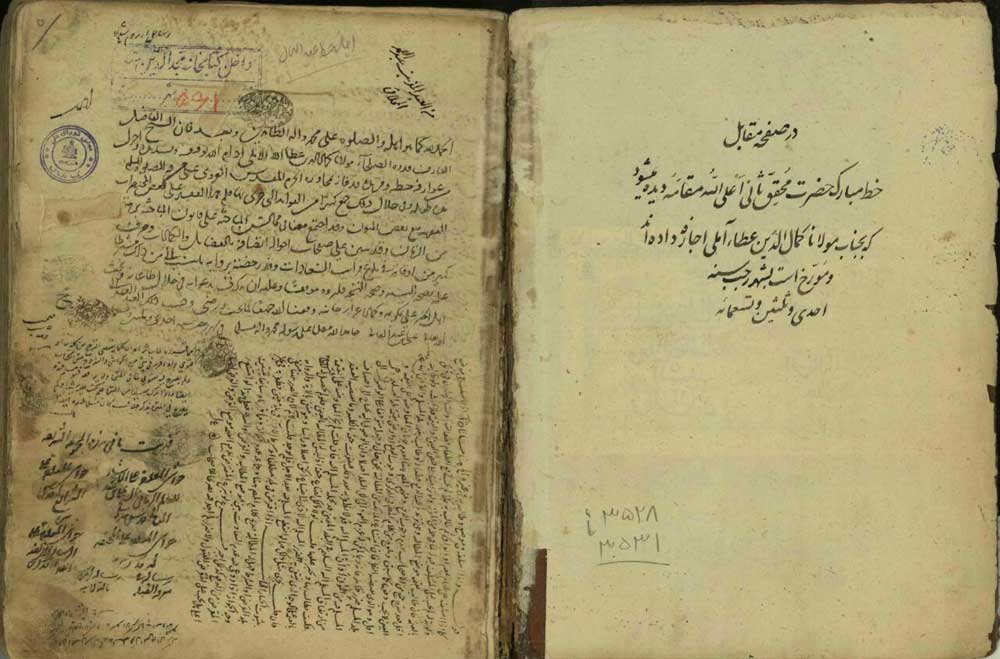
Finally, we should remember that Islamic maps exist in manuscripts—physical objects made of paper, ink, and pigment. They have weight and texture. They show signs of use. They were held, read, and studied by people centuries ago.
When we look at a digital image of an Islamic map, we’re seeing only part of the story. We’re missing the feel of the paper, the way the light catches the gold, the sense of connection to the past that comes from holding an object made by human hands centuries ago.
The Challenges of Study: What We Still Don’t Know
For all that we’ve learned about Islamic cartography, many mysteries remain. Let’s be honest about what we don’t know.
The Lost Originals
The earliest maps of the Balkhī tradition don’t survive in their original forms. We have copies made centuries later—the Gotha manuscript is from 1173, the Leiden manuscript from 1193, both more than two centuries after al-Iṣṭakhrī wrote. How faithfully do these copies reflect the originals? We can’t be sure.
The Book of Curiosities survives in a single manuscript, discovered only in 2000. Are there other unique manuscripts waiting to be found in library collections around the world? Almost certainly.
The Problem of Attribution
The relationships between the works of al-Balkhī, al-Iṣṭakhrī, and Ibn Ḥawqal are tangled and disputed . Manuscripts attributed to one author contain material that seems to come from another. Copyists added and changed material. The boundaries between one work and another blur.
This makes it difficult to say with confidence who created which map or when. We have to work with probabilities and careful analysis, not certainties.
The Unstudied Collections
Many Islamic manuscripts remain uncatalogued or poorly described. The University of Michigan’s collection includes over 1,100 volumes, but only a fraction have been digitized and studied in detail . Thousands more sit in libraries around the world, waiting for scholars to examine them.
The University of Jordan’s Center for Documents and Manuscripts contains more than 30,000 manuscripts, many from the Fatimid, Ayyubid, Mamluk, and Ottoman eras . They’ve been digitizing collections from across the Levant and North Africa for thirty years, but the work is far from complete.
The Destruction and Loss
Conflict and instability have destroyed countless manuscripts in recent decades. Libraries in Iraq, Syria, Yemen, and elsewhere have been damaged or destroyed. Manuscripts have been looted, burned, or simply lost. The University of Jordan’s digitization efforts began in part because “many original collections are now inaccessible or destroyed due to conflict.”
We’ll never know what we’ve lost. The manuscripts that survive are a fraction of what once existed.
A Practical Guide: What to Look For in an Islamic Map
If you’re new to Islamic maps and want to start exploring them—whether in a library, a museum, or an online collection—here’s what to look for.
Orientation
First, check the orientation. Many Islamic maps have south at the top. This can be disorienting if you’re used to modern maps, but it’s a clue to the map’s tradition. The Balkhī maps consistently use this orientation.
Shape and Style
Look at the overall shape. Is the world round? Are the seas rectangular? Are coastlines smooth or jagged? These features can help you identify which tradition a map belongs to.
The Balkhī maps are highly schematic. The Book of Curiosities maps are more varied. Al-Idrīsī’s maps are more detailed and realistic. Each tradition has its own visual vocabulary.
Place Names
Read the place names. What languages are they in? Arabic? Persian? Turkish? This tells you about the map’s origin and audience. What places are included? This tells you about the mapmaker’s interests and knowledge.
Decoration
Look at the decoration. Are there colors? Gold? Illuminated headings? These features suggest a luxury manuscript, probably produced for a wealthy patron. Plain maps with minimal decoration suggest a working copy for practical use.
Text
Remember that the map is part of a manuscript. Read the surrounding text if you can. What does it say about the map? What does it tell you about the geography of the region? The maps and text together create a complete picture.
Provenance
Look for ownership marks, library stamps, and marginal notes. These traces can tell you where the manuscript has been and who has used it. The University of Michigan’s collection includes “numerous manuscript notes documenting transmission, reading, borrowing, purchase, ownership and collecting” .
The Digital Turn: Accessing Islamic Maps Online
The good news is that you don’t have to travel to Leiden or Gotha to see Islamic maps. The digital revolution has made them more accessible than ever.
Major Digital Collections
Many libraries have digitized their manuscript collections and made them available online. The Qatar National Library has an extensive digitization program. The British Library’s Qatar Digital Library provides access to thousands of manuscripts, including maps.
The University of Michigan’s Islamic Manuscripts Collection has digitized many of its holdings . The Gotha Research Library provides digital access to its UNESCO-recognized manuscript . Leiden University Libraries has made its collections available through its Digital Collections portal.
Online Research Tools
Academic databases like JSTOR, Project MUSE, and Academia.edu provide access to scholarly articles on Islamic cartography. The work of Yossef Rapoport, Karen Pinto, Emilie Savage-Smith, and others is available through these platforms .
Wikipedia articles on the Book of Roads and Kingdoms and related topics provide accessible introductions, with bibliographies pointing to further reading .
What Digital Can’t Replace
But digital access has limits. You can’t see the true colors of a manuscript on a screen. You can’t feel the paper or see the way light catches gold leaf. You can’t read the marginal notes that are cropped out of digital images.
Digital surrogates are wonderful tools, but they’re not replacements. The best way to understand Islamic maps is still to see them in person, if you can.
The Bigger Picture: Islamic Maps and World Cartography
Where do Islamic maps fit in the broader history of cartography? How do they compare to other traditions?
Beyond the “Islamic vs. European” Framework
For a long time, scholars compared Islamic maps to European maps and found them wanting. European maps seemed more accurate, more scientific, more modern. Islamic maps seemed primitive, stylized, frozen in time.
That framework is now recognized as deeply flawed. It assumes that European cartography represents the natural endpoint of development—that maps were inevitably progressing toward something that looked like a modern road atlas. It ignores the different purposes Islamic maps served and the different contexts in which they were produced.
Karen Pinto’s “Medieval Islamic Maps” argues for understanding Islamic maps on their own terms, not as failed attempts to be something else . They are sophisticated visual artifacts that reward careful study.
Connections and Exchange
Islamic cartography didn’t develop in isolation. It drew on Greek sources, especially Ptolemy’s Geography, which was translated into Arabic in the 9th century. It incorporated knowledge from Persian and Indian traditions. It exchanged information with European mapmakers through contact points like Sicily and Spain.
Al-Idrīsī’s map is the most famous example of this exchange—an Islamic map made for a Christian king, drawing on multiple traditions. But there are many others. Ottoman mapmakers incorporated European charts. European mapmakers used Arabic sources. Cartography was a field of exchange as much as isolation.
The Enduring Relevance
Islamic maps remain relevant today, not just as historical artifacts but as ways of thinking about space and place. They remind us that maps are not transparent windows onto reality—they’re cultural products, shaped by the assumptions and values of their makers.
When we look at an Islamic map, we see a world organized around Islam. Mecca is at the center. The lands of Islam fill the map. Other regions appear only at the edges. This is not a failure of objectivity—it’s a statement of values. Every map makes similar statements, whether we notice them or not.
Islamic maps also remind us that accuracy is not the only virtue. A map can be useful without being precise. It can be beautiful without being realistic. It can be meaningful without being accurate. The Balkhī maps served their users well for centuries, not despite their schematism but because of it.
The Last Word: A World of Circles and Lines
Let me return to where I began: that round map in Leiden, with south at the top and Mecca at the center.
For eight hundred years, readers have opened that manuscript and looked at that map. They’ve traced the circle of the Encircling Ocean with their fingers. They’ve found Arabia, the Red Sea, the Persian Gulf. They’ve imagined the world as a place ordered by God, centered on Islam, bounded by water.
They didn’t need the map to be accurate in our sense. They needed it to be meaningful—to orient them in a world that was not just physical but spiritual, not just geographical but theological. And in that purpose, it succeeded brilliantly.
The map in Leiden is one of thousands of Islamic maps scattered through manuscript collections around the world. Each one has a story to tell—about the mapmaker who drew it, the patron who commissioned it, the readers who used it. Each one opens a window onto a different way of seeing the world.
At The Islamic Manuscripts Press of Leiden (IMPL), we’re committed to preserving and studying these maps. We believe they have something to teach us—not just about Islamic history, but about the nature of maps themselves. What they can be. What they can mean. How they can shape our understanding of the world.
The next time you look at a map—any map—remember that you’re looking at an argument, not a fact. A way of seeing, not a window onto reality. The map in front of you makes choices about what to include and what to leave out, what to emphasize and what to minimize. It reflects the values of its makers, whether you notice them or not.
Islamic maps make those choices visible. They remind us that every map is a world view, made by someone, for someone, with purposes we can learn to read.
References
- Smithsonian Libraries – Rapoport Y, “Islamic Maps” (Bodleian Library, 2020) *[Comprehensive overview of Islamic cartography from 9th-century Baghdad to 19th-century Iran, covering key mapmakers including al-Khwārazmī and al-Idrīsī]*
- Wikipedia – “Book of Roads and Kingdoms” *[Detailed article on the KMMS tradition, including Balkhī school, orientation with south at top, Ibn Khordadbeh’s 9th-century work, and Leiden MS Or. 3101]*
- University of Exeter – Agius DA, “Sea zones: The Balkhī School’s conceptual mapping of the Indian Ocean” (Topoi Orient-Occident, 2025) *[2025 study of Balkhī School cartography, their adoption of Greek models, and expansion to include Persian/Indian concepts of seven regions]*
- Smithsonian Institution – “Islamic maps Yossef Rapoport” [Catalog record with summary of Rapoport’s work on Muslim map-makers and their combination of cartography with art, science, and geographical knowledge]
- Universität Erfurt – “UNESCO World Documentary Heritage: An Arabic manuscript” *[UNESCO 2015 recognition of Gotha manuscript of al-Iṣṭakhrī’s work (1173 CE), containing 21 maps of the Islamic world, with detailed description of contents and acquisition history]*
- HAL Sorbonne Université – Nehmé L et al., “The Caravan Roads and Way Stations in North-West Arabia (CaRoWS) Project” (2026) [2026 archaeological fieldwork report with maps of ancient trade routes, providing context for understanding the routes described in geographical manuscripts]
- University of Michigan Library – “Islamic Manuscripts Collection: About the Collection” [Overview of one of North America’s largest Islamic manuscript collections, with over 1,100 volumes including geographical texts and Ottoman calligraphy]
- [Ashland University Library – Pinto KC,