Let me tell you about a moment that every manuscript researcher dreams of.
You’re in a library. Maybe it’s one of those grand European institutions with leather-bound catalogues and the smell of old paper. Or maybe it’s a smaller collection, the kind where you have to fill out slips and wait and hope. You’ve been looking at manuscripts for hours. Your eyes are tired. Your back hurts from hunching over. You’re thinking about coffee, about lunch, about anything except another page of dense Arabic script.
And then you see it.
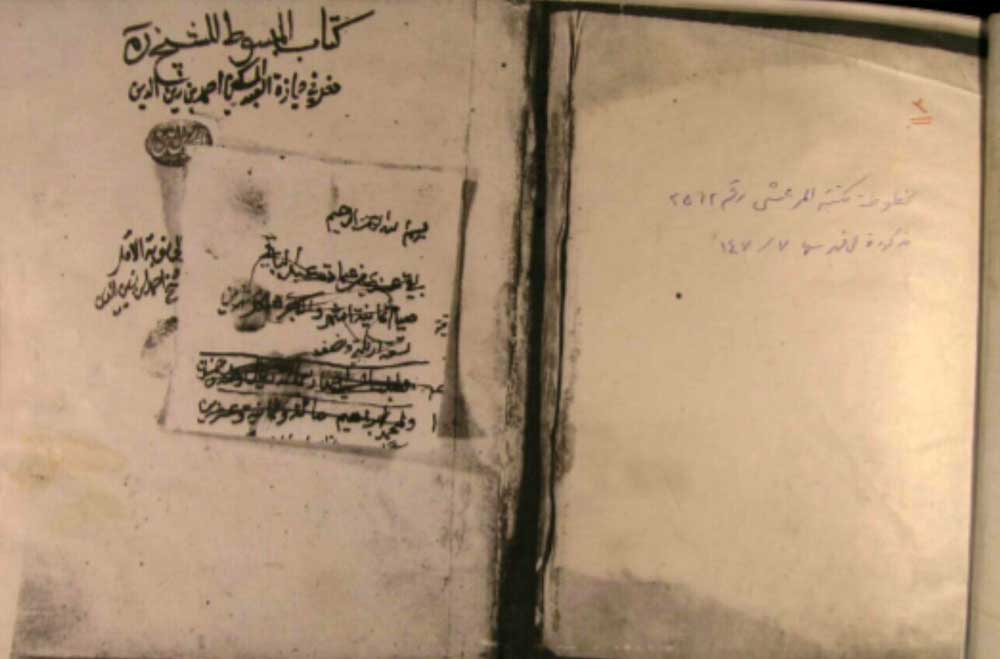
At the bottom of a page, in handwriting different from the main text, a note catches your eye. It’s not part of the official manuscript. It’s not supposed to be there. But there it is: “I annulled a marriage between two men, and I called upon a witness to its issuance, while I was in the court.”
Jolted out of your afternoon haze, you read it again. And again. Your heart races. What have you just found?
This really happened. In September 2019, researcher Shireen Hamza was working at the Biblioteca Ambrosiana in Milan, flipping through page after page of a Yemeni manuscript, when she encountered exactly this note. It was written in a clean, clear naskhi hand at the end of the codex. Not a single letter was smudged or worm-eaten. The first word even had a vowel marked, clarifying that this sentence was written in the first person. Someone, probably a judge or court official, had used this spare bit of paper to record something extraordinary: the annulment of a marriage that, upon closer examination, revealed complex questions about gender, law, and sexuality in 17th-century Yemen .
This is the power of marginalia. Not the main text, not the official record, but the scratches in the margins, the notes between the lines, the doodles and prayers and practice signatures that readers left behind. They are the whispers of the past, and if you learn to listen, they will tell you stories that no formal document ever could.
At The Islamic Manuscripts Press of Leiden (IMPL), we believe that manuscripts are not just texts to be read, but objects to be interrogated. Every mark on every page is evidence. Every marginal note is a conversation across centuries. And in this guide, I’m going to show you how to read those conversations—how to uncover the personal lives and historical events hiding in plain sight on the edges of Islamic manuscripts.
What Exactly Is Marginalia? (And Why Should You Care?)
Let’s start with definitions. The word “marginalia” simply means things written in the margins. In Arabic, the term is ḥāshiya (plural ḥawāshī), which literally means “edge” or “margin.” Over time, it became the conventional term for whatever readers wrote on the blank spaces of a manuscript .
But here’s the thing about margins: they’re where the real action happens.
The main text of a manuscript is the official version. It’s what the scribe was paid to copy, what the patron expected to receive, what the library catalogued and scholars cited. The margins, by contrast, belong to everyone else. They belong to the student who struggled with a difficult passage and wrote a note to remember what his teacher said. They belong to the owner who recorded the birth of a child on the flyleaf. They belong to the reader who argued with the author in tiny script, filling every available space with corrections and objections. They belong to the librarian who stamped the book when it entered a new collection, and to the thief who scratched out an ownership mark to hide where it came from.
Marginalia are messy. They’re unplanned. They’re personal. And that’s precisely what makes them so valuable.
Sheikh Fawzi Konaté, speaking at a 2026 seminar at the Cairo International Book Fair, explained that marginalia fall into two main types: marginal notes on commentaries and marginal notes on primary texts. Before the 10th century AH (roughly the 16th century CE), most marginalia were written on primary texts. After that, they increasingly appeared on commentaries . This shift tells us something important about how scholars read and thought—but we’ll come back to that.
Konaté also outlined the origins of marginalia. Often, they first appear on a student’s personal copy of a book, reflecting what he received from his teacher during the reading of the text. These notes then became available to the wider scholarly community in several ways: either the scholar compiled them himself, others compiled them during his lifetime, or his students collected them after his passing .
In other words, marginalia are the visible traces of an invisible process: the transmission of knowledge from teacher to student, from generation to generation. Without them, we would know much less about how Islamic learning actually worked.
The Scholar Who Didn’t Exist: Recovering Lives from the Margins
Let me introduce you to someone you’ve never heard of. His name was Muḥammad al-Muẓaffarī, and he lived in Cairo in the 16th century. He studied for decades with the city’s most prominent scholars. He read widely and thought deeply. He left behind more than 650 annotations scattered across 170 manuscripts.
And yet, by every conventional measure, he didn’t exist.
Al-Muẓaffarī wrote no books, no treatises. He appears in none of the biographical dictionaries that scholars of this period usually rely on. He had no entry in the historical chronicles. If you went looking for him in the standard sources, you would come up empty.
So how do we know about him? Through his marginalia.
Stephanie Luescher, a PhD candidate at Princeton University, has spent years reconstructing al-Muẓaffarī’s life from the notes he left in manuscripts. And what she’s found challenges everything we thought we knew about scholarly hierarchies in the premodern Islamic world .
Al-Muẓaffarī was not invisible because he lacked learning. On the contrary, his annotations reveal a sharp, engaged, well-read mind. He was invisible because he lacked the lineage, social networks, and material resources that would have granted him access to scholarly recognition. He was a man of modest means in a world where scholarship was as much about who you knew as what you knew.
Luescher’s research shows that the prevailing view of premodern Islamic scholarly hierarchies as meritocratic is wrong. The system systematically marginalized scholars of modest means, leaving them to fade from history—except for the traces they left in the margins of books .
This is what marginalia can do. They can recover lives that would otherwise be lost. They can give voice to the voiceless and visibility to the invisible. In a field that has traditionally focused on famous authors and major works, marginalia remind us that history is made by countless ordinary people whose names we will never know—but whose marks we can still read.
The Margins as Documentary Evidence: Law, Gender, and Everyday Life
Remember that Yemeni manuscript I mentioned at the beginning? The one with the note about annulling a marriage? Let’s go back to it, because it’s a perfect example of how marginalia can illuminate aspects of the past that official records ignore.
The note, written in 1064 AH (1654 CE), reads:
“I annulled a marriage between two men, and I called upon a witness to its issuance, while I was in the court. By [the witness] I mean, one who puts his name after my note here” .
At first glance, this seems to record a same-sex marriage—something that would be extraordinary in any context, let alone 17th-century Yemen. But Shireen Hamza, the researcher who found it, dug deeper. She consulted the work of historian Sara Scalenghe, who documented several cases from the same period where courts intervened in marriages to rule on a person’s gender .
In one case, a teenage boy named Ali was found by physicians to be a girl, after it came to the court’s attention that a man was in love with him. In another, a pious man named Muhammad was married to a woman who was an “obvious khunthā” (a person of ambiguous gender), but a cousin and rejected suitor brought their marriage to the attention of the city’s ruler. After women medical practitioners found “her” to be a man, the Amir punished them both .
Hamza’s conclusion? The note likely records a situation where someone officiated a marriage between two people: one was a man, and the other was either a woman or a khunthā. Later, a court decided that the latter person was actually a man, and thus the marriage was annulled .
But here’s what makes this marginal note so valuable. It’s not an official court record. It’s not a legal treatise. It’s a private note, probably written by a judge or court official, practicing on a spare bit of paper before copying it onto an official document, or jotting down a memorable case for his own reference. It’s informal, personal, and therefore more honest than the formal record might have been.
As Hamza notes, “this kind of ‘documentary’ source, which records the practice of law, is a crucial resource for historians of gender and sexuality as well as for feminist scholars of Islamic law” .
The margins, in other words, show us what actually happened, not just what was supposed to happen. They reveal the gap between legal theory and legal practice, between official norms and everyday realities.
The Crypto-Muslims of Spain: Survival in the Margins
Sometimes the margins aren’t just on the page—they’re in the very existence of the manuscript itself.
Consider the manuscript of Ocaña. In 1969, workers restoring a house in Ocaña, Spain, found something hidden in a wall: a small, pocket-sized Islamic compendium written in Arabic. It had been there for centuries, concealed by Muslims who chose to remain in Spain after the Christian Reconquista, living as crypto-Muslims under the watchful eye of the Inquisition .
This manuscript, now the subject of a PhD thesis by Haifa Fersi at the University of Kent, is a testament to survival. Its owners hid it in a wall to save it from the biblioclasm that consumed so many Islamic books. They risked their lives to preserve their faith, their language, their identity .
But here’s what’s really interesting: the manuscript itself contains marginalia that reveal how its owners used it. It was a practical sermon-guide, used to instruct a secret community of believers. Over time, as the community’s knowledge of Arabic faded and their practice of Islam became increasingly domestic and private, the manuscript transformed from a teaching tool into something else: a sacred relic, an object of devotion in itself .
Fersi argues that the manuscript “materialises their journey from the secluded Mudejar districts pushed to the outskirts of cities to the underground Morisco households lurking under surveillance.” The marginalia, the wear patterns, the signs of use—all of these tell a story of gradual loss. When the ideal Islamic space of the manuscript could no longer be represented in everyday life, and the sense of a shared community vanished with the domestication of religion, the end of Islam in Spain was inevitable .
This is marginalia as archaeology. Every mark on every page is a layer of occupation, a trace of habitation. By reading these traces, we can reconstruct not just individual lives, but the life and death of a whole community.
The Many Functions of Marginalia: What Readers Actually Did
So what were readers doing when they wrote in the margins? Sheikh Fawzi Konaté, in his Cairo seminar, summarized the purposes into three principal functions: clarifications, verifications, and critical refinements .
Let’s unpack each one.
Clarifications
A reader encounters a difficult passage. Maybe the author assumed knowledge the reader doesn’t have. Maybe the handwriting is ambiguous. Maybe the text itself is corrupt. In the margin, the reader writes an explanation: “This means X,” or “The author is referring to Y,” or “This should read Z.”
These clarifications are gold for modern researchers. They tell us what readers found difficult, what they thought the text meant, how they understood it. They’re a window into the reception history of the work.
Verifications
A reader checks the text against another copy, or against what they remember from their teacher. They find a discrepancy. In the margin, they note it: “In another copy, this reads…” or “My teacher said this should be…” These notes are crucial for establishing the textual tradition. They show us how manuscripts were corrected, how errors crept in, how scholars tried to maintain accuracy.
Critical Refinements
This is where it gets really interesting. A reader disagrees with the author. They think the argument is weak, the interpretation forced, the conclusion wrong. In the margin, they argue back. They write objections, counter-arguments, alternative interpretations. They engage in a dialogue across time with a dead author.
These critical refinements show us that reading was not passive. It was active, engaged, even combative. Scholars wrestled with texts, pushed back against them, refined them. The margins are where this intellectual work happened.
The Material Evidence: What the Physical Object Reveals
Marginalia aren’t just about content. They’re also about materiality. Where on the page is the note written? What kind of ink was used? Is it the same hand as the main text, or different? All of these details matter.
The MeMo project, based at the University of Cassino, has been studying the “life” of medieval manuscripts through exactly this kind of evidence. As they put it: “If the history of a codex begins with its copying and physical assembly, it certainly does not end there. Manuscripts are read, annotated, corrected, sometimes dismantled, restored, or reassembled; they move across places and contexts often far removed from those for which they were originally produced. Marginalia, traces of reading, decorative interventions, and structural modifications testify to these transformations” .
In other words, a manuscript is not a static object. It’s a living thing that changes over time. Each new reader leaves their mark. Each new owner adds their layer. The marginalia are the fossil record of this ongoing process.
Richard McGregor’s research at the American Research Center in Egypt explores this from another angle. He studies devotional manuscripts from the Mamluk and Ottoman periods, focusing on how readers interacted with them as physical objects. People didn’t just read these texts—they touched them, kissed them, rubbed them. They left traces of bodily interaction: pious notes, supplications, interpretations .
McGregor argues that “the practice of bodily interaction with texts in fact took many forms. Not only were illustrations representing, for example, the Prophet’s tomb in Medina rubbed and kissed, but sometimes names were similarly treated” .
This is a different kind of marginalia—not written, but physical. The wear patterns on a page, the smudges, the fingerprints, the places where the ink has been rubbed away by devoted fingers—all of these are evidence of how people used books. And all of them tell us something about the role of manuscripts in religious life.
The Problem of Provenance: How Manuscripts Move and Margins Travel
One of the most challenging aspects of working with marginalia is provenance—the history of where a manuscript has been and who has owned it. Manuscripts are mobile objects. They migrate across regions, institutions, and epistemic frameworks. This movement profoundly shapes their visibility, accessibility, and scholarly legibility .
A manuscript produced in 13th-century Cairo might end up in 15th-century Damascus, then 17th-century Istanbul, then 19th-century Paris, then 20th-century Princeton. At each stop, it accumulates new marginalia: ownership statements, library stamps, shelfmarks, readers’ notes. These are not just decorations—they’re evidence of the manuscript’s journey.
The Centre for Manuscript and Text Cultures at Oxford recently issued a call for papers on “Forgotten Libraries”—manuscript collections that have been lost, dispersed, or marginalized. They note that “many manuscripts survive in ways that render them effectively invisible: scattered across different holdings, insufficiently catalogued, marginalised by new political and linguistic orders, or remembered only through fragmentary references” .
This is where marginalia become essential. A single codex may preserve traces of an otherwise vanished collection. An isolated manuscript may retain ownership marks, organizational clues, or textual relationships that point back to a forgotten ensemble. By reading these traces carefully, we can sometimes reconstruct collections that no longer exist and recover libraries that have been lost.
The Margins of Philosophy: Thinking in the Margins
Marginalia aren’t just for historical or documentary purposes. They’re also philosophical. In 2026, De Gruyter Brill published a major open-access volume titled “Thinking in the Margins: Marginalia in Medieval and Renaissance Philosophy,” edited by Mario Meliadò. The book examines the special status of marginalia as an object of historical-philosophical interpretation .
The chapters cover Latin, Arabic, and Hebrew philosophical traditions, reflecting on the practices of reading and writing from which marginalia emerged. One chapter, titled “The Uncharted Margins of Arabic Philosophy,” explores exactly the kinds of notes we’ve been discussing—but with a focus on what they tell us about philosophical thought .
When a philosopher writes in the margin of Aristotle, they’re not just taking notes. They’re thinking. They’re wrestling with ideas, testing arguments, refining concepts. The margin is where philosophy happens—not just in finished treatises, but in the messy, provisional, exploratory space of engagement with texts.
This is a crucial insight. Marginalia are not just sources for social history. They’re sources for intellectual history. They show us how thinkers actually thought, not just what they ended up publishing.
The Moroccan Exception: When the Margins Become the Center
Let me circle back to a point I touched on earlier. Most scholarship on Islamic law has focused on the Ḥanafī school, which was dominant in the Ottoman Empire and much of the Islamic world. But Morocco is different. It follows the Mālikī school, and that difference matters—especially for understanding marginalia.
Jessica Marglin’s research on Moroccan shari’a courts in the 19th century shows that written documents played a much larger role in legal procedure than the standard historiography would suggest. In fact, notarized documents could outweigh oral testimony—traditionally thought of as the gold standard of evidence in Islam .
This had particular implications for Jews, who as dhimmīs could not give oral testimony against Muslims in court. But in Morocco, Jews had equal access to notarized documents, and thus stood on a playing field that was level with their Muslim neighbors. They could present written evidence, and judges accepted it .
Marglin’s work begins from a provocative premise: “that the margins can shine light on the center.” She uses the experience of Jews (thought of as marginal in the Islamic world) in Moroccan courts (similarly thought of as marginal in Islamic history) to tell a new story about orality and writing in Islamic law .
This is exactly what marginalia do. They take what has been pushed to the edges—geographically, institutionally, socially—and use it to illuminate the whole. The margins are not peripheral. They’re central to understanding how things actually worked.
A Practical Guide: How to Read Marginalia
If you’re new to working with manuscripts, the prospect of reading marginalia can be daunting. The handwriting is often messier than the main text. The notes are sometimes in multiple languages. They reference people and events you’ve never heard of. Where do you even start?
Here’s a practical approach.
Step 1: Look at Everything
Before you read a single word, look at the manuscript as a physical object. Where are the notes? Are they concentrated in certain sections? Are they in the margins, between lines, on flyleaves? Are there different hands? Different inks?
Step 2: Categorize the Notes
Start sorting what you see. Which notes are corrections? Which are explanations? Which are arguments? Which are ownership marks? Which are devotional? Each category tells you something different.
Step 3: Read the Notes in Context
Don’t read marginalia in isolation. Read them alongside the main text. What passage prompted this note? What was the reader responding to? This is how you understand what they were thinking.
Step 4: Look for Patterns
Do certain types of notes appear together? Do certain readers have characteristic habits? Are there patterns in where notes appear—more in some sections than others? Patterns reveal the reader’s interests and priorities.
Step 5: Compare Across Manuscripts
If you have multiple manuscripts of the same text, compare their marginalia. Do the same notes appear in different copies? That might indicate they come from a common source, like a teacher’s commentary. Do different readers make different kinds of notes? That tells you about different reading communities.
Step 6: Don’t Forget the Obvious
Sometimes the most valuable information is the simplest. A date. A name. A place. These are the building blocks of provenance. Record them carefully.
The Future of Marginalia Studies
The study of marginalia is changing rapidly. Digital humanities tools are making it possible to analyze patterns across hundreds or thousands of manuscripts. Projects like MeMo are digitizing collections and developing platforms for research . Workshops and conferences are bringing together scholars working across different traditions and periods .
But the fundamentals remain the same. Marginalia are evidence of human engagement with texts. They’re personal, idiosyncratic, and irreplaceable. No digital surrogate can fully capture the experience of holding a manuscript and seeing the marks that readers left centuries ago.
At The Islamic Manuscripts Press of Leiden (IMPL), we’re committed to preserving and studying these traces. We believe that every manuscript has a story to tell—not just through its main text, but through every note, doodle, and smudge on its pages. These are the stories that official histories forget. These are the lives that biographical dictionaries miss. These are the voices that deserve to be heard.
The Last Word: Why Marginalia Matter
Let me end where I began: with that moment of discovery in a library, when a marginal note jumps off the page and grabs you by the throat.
Shireen Hamza found a note that made her heart race. Stephanie Luescher found 650 annotations that reconstructed an invisible scholar’s life. Haifa Fersi found a manuscript hidden in a wall that told the story of crypto-Muslims in Spain. Richard McGregor found traces of devotional practice that revealed how people touched and kissed sacred texts. Jessica Marglin found legal documents that upended everything we thought we knew about Islamic law.
None of these discoveries would have been possible without marginalia. Without the scratches in the margins, the notes between the lines, the traces left by ordinary readers and writers, these stories would be lost forever.
That’s why marginalia matter. They’re not just footnotes to history. They’re history itself—messy, personal, unfiltered. They’re the voices of people who never made it into the official record, who never wrote books or held high office, who simply read and wrote and thought and lived.
In the margins, they survive. In the margins, they speak. And if we learn to listen, they will tell us stories we never imagined.
References
- Princeton University – “Invisible Scholars in the Margins of Medieval Islamic Manuscripts” (NES Seminar Series) *[Seminar description detailing Stephanie Luescher’s research on Muḥammad al-Muẓaffarī, a 16th-century Cairene scholar known only through 650+ annotations in 170 manuscripts, challenging meritocratic views of scholarly hierarchies]*
- Centre for Manuscript and Text Cultures, Oxford – “Call for Papers: Forgotten Libraries” (February 2026) [2026 workshop announcement on neglected manuscript collections, addressing how manuscripts migrate and become invisible, and the importance of ownership marks and organizational clues]
- Muslim Council of Elders – “A Methodological Reading of Marginalia in Islamic Heritage” (Cairo International Book Fair, January 2026) [Seminar with Sheikh Fawzi Konaté on ḥawāshī, defining types of marginalia, their origins in teacher-student transmission, and three principal functions: clarifications, verifications, and critical refinements]
- JHI Blog – “Annulling the Marriage of Two Men: A Marginal Note in a Yemeni Manuscript” (June 2020) [Shireen Hamza’s discovery of a 1654 CE marginal note in Biblioteca Ambrosiana manuscript Arabi Nuovo Fondi E437, documenting marriage annulment and revealing complex gender history in Islamic law]
- MeMo Project, Università di Cassino – “MeMo in Dialogue with International Research” (March 2026) [Presentation of research on the “life” of medieval manuscripts, emphasizing marginalia and traces of reading as evidence of transformation and intellectual impact across communities]
- Semantic Scholar – Marglin JM, “Written and Oral in Islamic Law” (Comparative Studies in Society and History, 2017) [Academic abstract arguing that margins illuminate the center, using Jewish experience in Moroccan courts to challenge assumptions about orality and writing in Islamic law]
- Kent Academic Repository – Fersi H, “Living on the Edge: The Manuscript of Ocaña” (PhD thesis, 2019) [Doctoral dissertation on a crypto-Muslim manuscript hidden in a Spanish wall, examining marginalia as evidence of survival, gradual language loss, and the domestication of Islam under Inquisition]
- De Gruyter Brill – Meliadò M (ed.), “Thinking in the Margins: Marginalia in Medieval and Renaissance Philosophy” (Open Access, 2026) [2026 scholarly volume on marginalia in Latin, Arabic, and Hebrew philosophical traditions, including chapter “The Uncharted Margins of Arabic Philosophy” and analysis of readers’ marks]
- Cambridge Core – Marglin JM, “Written and Oral in Islamic Law” (Comparative Studies in Society and History, 2017) [Full article on documentary evidence in Moroccan shari’a courts, demonstrating that written documents could outweigh oral testimony, with implications for Jewish plaintiffs]
- American Research Center in Egypt – “Richard McGregor: Text and Ritual in Medieval Islamic Piety” (2021-2022 Fellowship) [Research on devotional manuscripts in Mamluk and Ottoman periods, examining marginalia as evidence of bodily interaction with texts, pious notes, supplications, and ritual use in madrasas]
- The Islamic Manuscripts Press of Leiden (IMPL) – Official Website *[Dedicated to the preservation, study, and publication of Islamic manuscripts, offering resources for understanding manuscript cultures and marginalia]