The Golden Age of Islamic Manuscripts: How Science and Art Flourished in Medieval Bookmaking
Picture a world without search engines. A world where a single question—like how the planets move, why we get sick, or how to solve a complex equation—could take a lifetime to answer. Now, imagine you’re a scholar in 9th-century Baghdad. You have a question. Instead of typing it online, you walk into a grand institution called the House of Wisdom (Bayt al-Hikma). Within its walls, you don’t just find one book; you find mountains of them. But these aren’t ordinary books. They are masterpieces of human ingenuity, where complex scientific diagrams dance on the same page as poetry written in liquid gold, where the binding is a work of leather and metal art, and the paper itself seems to glow.
This was the reality of the Islamic Golden Age, a period roughly spanning the 8th to the 14th centuries. And at the very heart of this unprecedented bloom of knowledge and culture was a revolutionary object: the Islamic manuscript. These weren’t merely containers for text; they were the very engines of civilization. They were how knowledge was captured, debated, beautified, and sent racing across continents—from Spain and Morocco in the west to the borders of China in the east.
For too long, the narrative of the “Dark Ages” in Europe has overshadowed the brilliant light shining elsewhere. While one part of the world was fragmenting, another was building a vast, interconnected network of thought. This article is an invitation to step into the workshops, libraries, and marketplaces of that world. We’ll explore how the humble act of making a book became a sublime fusion of cutting-edge science, lavish art, and profound spiritual devotion. It’s a story of how Islamic manuscripts didn’t just preserve ancient knowledge—they supercharged it, illustrated it, and passed it on, ultimately lighting the fuse for the European Renaissance.
At The Islamic Manuscripts Press of Leiden (IMPL), we live and breathe this legacy every day. Based in a city that has been a center of manuscript study for centuries, our mission is to continue the work of those medieval scribes and scholars: to preserve, understand, and share these treasures with the world. Just as the House of Wisdom once gathered texts from Greece, Persia, and India, we strive to be a modern hub for this global heritage.
More Than Words: The Manuscript as a Total Work of Art
To understand the Islamic manuscript, you must first forget the modern, mass-produced paperback. Each manuscript was a custom-made, hand-crafted universe. Its creation was a symphony performed by a team of highly specialized artisans, each a master of their craft. The process was slow, expensive, and required a patron—a caliph, a sultan, a wealthy merchant, or a religious institution—who believed in the power of the book.
The journey of a single manuscript could involve:
- The Papermaker: Introducing paper from China, a far more efficient medium than papyrus or parchment.
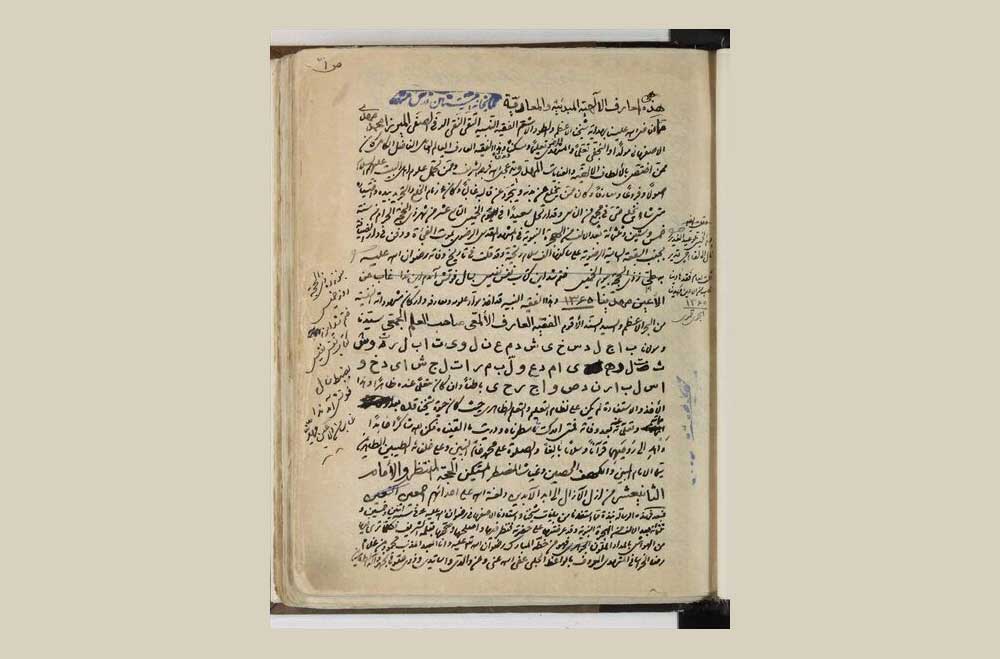
- The Calligrapher: The star of the show, turning Arabic script into a spiritual and visual art form.
- The Illuminator: Painting intricate geometric and floral designs in gold and vibrant colors.
- The Illustrator: Creating detailed scientific diagrams, medical drawings, or narrative miniatures.
- The Binder: Crafting a durable and beautiful cover to protect the precious contents.
This collaborative spirit meant that a single volume on astronomy could be a textbook, a work of art, and a testament to technological prowess, all bound together.
The Foundation: Paper, Ink, and the “Tech Transfer” That Started It All
The story begins with a material we take for granted: paper. Before its arrival, the Islamic world used parchment (animal skin) and papyrus. But in the 8th century, following the Battle of Talas (751), Muslim artisans learned the secrets of papermaking from Chinese prisoners. This was a game-changer.
Paper was cheaper, more abundant, easier to write on, and better suited to the fine, flowing lines of Arabic script. The Islamic world didn’t just adopt this technology; they industrialized it. By the 10th century, paper mills in Baghdad, Damascus, and later in Islamic Spain were producing sheets of exceptional quality. This democratized knowledge. More books could be produced faster and for less money, fueling an explosion of literacy and scholarship.
Alongside paper, ink recipes became a science of their own. Scribes used carbon-based black inks, but also exquisite colored inks from minerals and plants. The most prestigious was gold ink, made from real gold powder suspended in a binder, used for the names of God, royal titles, and chapter headings. At IMPL, when we analyze these materials today, we’re not just seeing colors; we’re reading a chemical recipe book from a thousand years ago, telling us about trade routes and artistic priorities.
The Sacred Script: Calligraphy as the “Geometry of the Spirit”
If paper was the stage, then Arabic calligraphy was the lead actor. In a culture where depicting the human form was often avoided in religious contexts, writing became the primary visual art. The Arabic script, used to record the divine words of the Qur’an, was seen as sacred. Writing it beautifully was an act of piety.
Calligraphers weren’t just writers; they were designers and mathematicians. They developed a complex system of proportional rules, often based on the size of the dot made by their reed pen (qalam). Different scripts emerged for different purposes:
- Kufic: Angular, majestic, and formal, often used for early Qur’ans and architectural inscriptions.
- Naskh: Clear, legible, and cursive, it became the standard for copying books and, eventually, for printing.
- Nasta’liq: The “bride of calligraphy,” a flowing, elegant Persian script that seems to dance across the page, perfect for poetry.
A master calligrapher would spend decades perfecting his craft. The goal was to achieve a balance of black and white on the page—not just the ink, but the space around it—creating a rhythm that was as pleasing to the soul as it was to the eye. It was, as the scholars called it, “the geometry of the spirit made visible.”
Illumination: Painting with Light
Surrounding this sacred text was illumination (tadhib). This is the art of decorating the manuscript with gold, silver, and brilliant colors. The term itself means “to fill with light,” and that’s precisely the effect.
Illumination wasn’t random decoration. It followed a strict architectural plan to guide the reader:
- The ‘Unwan: The magnificent headpiece or title page at the beginning of a chapter. It could be a dazzling burst of geometric patterns, arabesques, and floral motifs.
- Marginal Decorations: Finials, medallions, and tiny vignettes in the margins.
- Chapter Headings: Often written in gold or colored ink within decorative panels.
The most iconic motif is the arabesque: an endlessly repeating, interlacing pattern of vines, leaves, and flowers. It’s more than just pretty; it’s philosophical. The arabesque represents the infinite, unending nature of God’s creation, with no beginning and no end. It’s a visual meditation.
For secular manuscripts, like poetry or scientific works, illustrators painted miniatures. These small, detailed paintings could depict courtly scenes, battles, stories, or, crucially, scientific instruments, plants, and animals. A manuscript on medicine, like al-Razi’s Liber Continens, might contain precise drawings of surgical tools. An astronomy text would feature intricate diagrams of the cosmos. This marriage of accurate illustration with authoritative text made these manuscripts incredibly powerful tools for teaching and discovery.
The Knowledge Contained: From Stars to Surgery
So, what was actually written inside these beautiful objects? Everything. The Islamic Golden Age was fundamentally interdisciplinary. The same scholar might write about philosophy, medicine, and optics. Manuscripts were the vessels for this intellectual ferment.
The Translation Movement: Saving the Classics
It all started with a massive, state-sponsored project of translation. Under the Abbasid Caliphs in Baghdad, teams of scholars—often including Christians, Jews, and Sabians—were paid to translate the entire known corpus of Greek, Persian, and Indian science and philosophy into Arabic. Works by Plato, Aristotle, Ptolemy, Galen, and the Indian mathematician Brahmagupta were saved from oblivion. As one famous saying goes, “The ink of the scholar is more holy than the blood of the martyr.” This wasn’t just preservation; it was the creation of a new, common language of science.
The Observatory and the Hospital: Science in Action
Manuscripts were the lab notebooks and peer-reviewed journals of their day.
- Astronomy & Mathematics: Scholars like al-Khwarizmi (whose name gives us “algorithm”) systematized algebra. Al-Biruni calculated the earth’s radius with remarkable accuracy. Their works, filled with complex tables and trigonometric diagrams, were copied and studied for centuries.
- Medicine: Ibn Sina’s (Avicenna) The Canon of Medicine was a million-word encyclopedia used as a standard medical textbook in Europe and the Islamic world for over 600 years. Its manuscripts contain detailed diagrams of the human body, lists of ailments, and compound medicines.
- Optics & Engineering: Ibn al-Haytham’s Book of Optics revolutionized the field, correctly explaining how vision works. Manuscripts of engineering works, like al-Jazari’s The Book of Knowledge of Ingenious Mechanical Devices, are wonders in themselves, containing instructions (and beautiful paintings) for everything from water clocks to automated musical robots.
These manuscripts didn’t stay put. They traveled along trade routes, were sold in busy book markets (suq al-warraqin), and were carried by pilgrims to Mecca. Knowledge circulated at a speed the world had never seen.
The Modern Legacy: How We Study These Treasures Today
The story doesn’t end in the 14th century. Hundreds of thousands of these manuscripts survive today, residing in libraries from Istanbul’s Topkapi Palace to the Chester Beatty in Dublin, from the Bibliothèque nationale de France to the collections right here in Leiden University Library. They are not just relics; they are active subjects of cutting-edge research.
The Digital Revolution
Projects like the Qatar Digital Library and The Islamic Manuscripts Association (TIMA) are undertaking a modern translation movement: digitization. Using high-resolution, multi-spectral imaging, we can now see erased text, uncover palimpsests (where a later text was written over an earlier one), and analyze ink composition without touching the page. This allows a global audience, from a professor in Princeton to a student in Jakarta, to study the same manuscript simultaneously. It’s a new House of Wisdom, built in the cloud.
Science Meets the Script
Modern laboratories are unlocking secrets invisible to the naked eye:
- Spectroscopy can identify the specific minerals in a pigment, telling us about trade in lapis lazuli (from Afghanistan) or vermilion.
- Radiocarbon Dating helps verify the age of paper and parchment.
- Codicolgy—the “archaeology of the book”—studies bindings, sewing techniques, and paper watermarks to understand a manuscript’s history and origin.
At The Islamic Manuscripts Press of Leiden (IMPL), we are at the forefront of this work. Our publications bridge the gap between deep academic scholarship and public fascination, ensuring that the insights gleaned from these technical analyses are shared with the world. You can explore our catalog and mission on our About page.
A Living Tradition
The Golden Age of Islamic manuscripts is often spoken of in the past tense. But look closer. The art of calligraphy is vibrantly alive, taught in schools and practiced by artists worldwide. The geometric principles of illumination inspire modern architects and designers. The spirit of that age—a reverence for knowledge, a belief in the unity of science and art, and a commitment to preserving and building upon the past—is more relevant than ever.
When you look at a digitized page of a 13th-century Qur’an or a copy of Ibn Sina’s Canon, you’re not looking at a dead artifact. You’re looking at a conversation that has been ongoing for over a millennium. You’re seeing the moment when a human hand, guided by curiosity and faith, reached out across time to share a discovery, a story, or a prayer. The manuscript was their internet, their university, and their art gallery. And in its delicate pages and glowing gold, we can still find a blueprint for a world enlightened by knowledge.
At The Islamic Manuscripts Press of Leiden, we are dedicated to keeping this conversation alive. Explore our latest publications and discoveries, and join us in uncovering the endless stories waiting in the margins. Visit our homepage to begin your journey into this golden age.
References & Further Reading
- The David Collection, Copenhagen – Islamic Manuscripts: https://www.davidmus.dk/en/collections/islamic/materials/manuscripts
- The Metropolitan Museum of Art – The Art of the Qur’an: https://www.metmuseum.org/exhibitions/listings/2016/art-of-the-quran
- Library of Congress – Islamic Manuscripts from Mali: https://www.loc.gov/collections/mali-islamic-manuscripts/about-this-collection/
- British Library – Asian and African Studies Blog (Islamic Manuscripts): https://blogs.bl.uk/asian-and-african/
- Qatar Digital Library – A vast archive of digitized Islamic manuscripts: https://www.qdl.qa/en
- The Islamic Manuscript Association (TIMA): https://www.islamicmanuscript.org/
- University of Cambridge – The Cambridge Digital Library (Islamic Collections): https://cudl.lib.cam.ac.uk/collections/islamic
- “The Manuscript Tradition” by François Déroche: https://www.hup.harvard.edu/catalog.php?isbn=9780674053276 (A key academic text)
- “Islamic Art and Architecture” by Robert Hillenbrand: https://www.thamesandhudson.com/Islamic-Art-and-Architecture-9780500203057
- “In the Shadow of the Sword” by Tom Holland (for historical context on early Islam): https://www.hachettebookgroup.com/titles/tom-holland/in-the-shadow-of-the-sword/9780385531379/