Islamic Calligraphy Manuscripts: History, Styles, Art & Hidden Stories
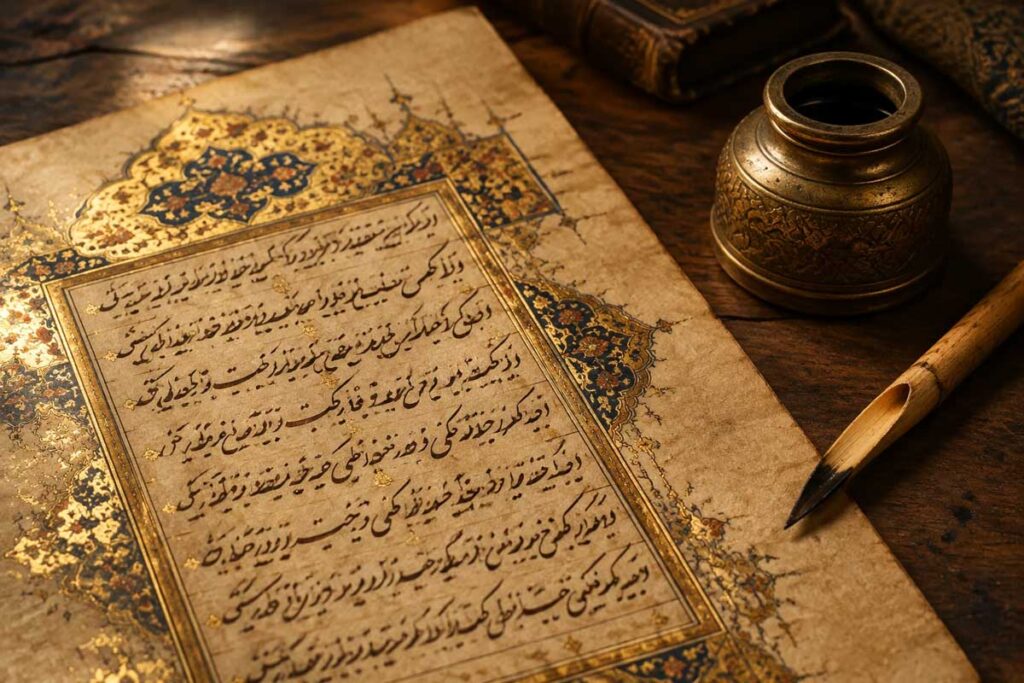
When you see the phrase Islamic Calligraphy Manuscripts, you may picture an old Qur’an sitting quietly behind glass in a museum. Perhaps the pages are covered with elegant Arabic letters, gold decoration, and patterns that look almost too perfect to have been made by hand.
But an Islamic manuscript is much more than an old book.
It can be a record of faith, scholarship, politics, trade, art, science, and everyday life. A single page may tell us something about the person who wrote it, the materials available in a particular city, the tastes of a royal court, or the way knowledge moved from one part of the world to another.
For readers interested in the history of these remarkable objects, Manuscripts Leiden offers a useful place to explore Islamic manuscript culture, scholarship, and the stories hidden inside handwritten texts. The Islamic Manuscripts Press of Leiden focuses on publishing carefully edited works of Islamic scholarship, including texts that survive only in manuscript form.
So, what makes Islamic calligraphy manuscripts so special?
The answer is not simply beautiful handwriting. It is the combination of writing, material, craftsmanship, history, and human patience.
And yes, patience was very important. Medieval scribes did not have a Ctrl+Z button.
What Are Islamic Calligraphy Manuscripts?
An Islamic calligraphy manuscript is, in simple terms, a handwritten work produced within the cultural and intellectual worlds of Muslim societies, where the written word is often given a highly developed visual form.
The term can cover many different kinds of books and documents.
These include:
- Qur’anic manuscripts
- Hadith collections
- Religious commentaries
- Poetry
- Philosophy
- Medicine
- Astronomy
- Mathematics
- Law
- History
- Scientific works
- Letters and official documents
- Calligraphic albums and individual calligraphy sheets
This is important because Islamic manuscripts are not all religious books.
A manuscript produced in a Muslim society could discuss medicine, astronomy, mathematics, literature, philosophy, or government administration. The manuscript tradition was part of a much larger culture of learning.
At Manuscripts Leiden, this broader understanding of manuscript culture is central to the organisation’s work. Its stated areas include premodern philosophy, Sufism, Shi‘i mysticism, Qur’anic exegesis, and Islamic theology.
In other words, when we talk about Islamic Calligraphy Manuscripts, we are not simply talking about decorative writing.
We are talking about a huge historical world.
Why Is Calligraphy So Important in Islamic Manuscripts?
Calligraphy occupies a special place in Islamic art.
One reason is obvious: writing was essential to the transmission of the Qur’an and other forms of knowledge. But over centuries, writing developed into something much more sophisticated than a practical method of recording words.
The shape of a letter mattered.
The distance between letters mattered.
The thickness of the line mattered.
The position of a word on the page mattered.
Even the empty space around the writing could be part of the design.
UNESCO describes Arabic calligraphy as an artistic practice in which Arabic script is written in a fluid way to create harmony, grace, and beauty. In 2021, Arabic calligraphy: knowledge, skills and practices was inscribed on UNESCO’s Representative List of the Intangible Cultural Heritage of Humanity.
This recognition is significant because it reminds us that calligraphy is not only an object from the past.
It is also a living tradition.
Calligraphy Was More Than “Nice Handwriting”
Imagine writing an entire book by hand.
Now imagine that the book is sacred or extremely valuable.
Now imagine that there is no printer.
And no spell-check.
And no backspace.
A mistake could have serious consequences.
Calligraphers therefore developed highly disciplined methods. They learned how to prepare their pens, control ink flow, construct letters, maintain proportions, and organize entire pages.
The result was a form of writing in which practical communication and visual art became deeply connected.
The Library of Congress notes that the growth of Qur’anic production contributed to major stylistic developments in Arabic calligraphy. Over time, early Kufic traditions were complemented and then increasingly replaced for many purposes by more fluid scripts associated with the so-called “Six Pens.”
That evolution is one of the most fascinating parts of the story.
The Main Styles of Islamic Calligraphy
There is no single “Islamic handwriting.”
Different regions, periods, languages, and purposes produced different styles.
Some are angular and monumental.
Others are soft and flowing.
Some look highly geometric.
Others appear almost as if the letters are dancing across the page.
Here are several of the most important styles.
Kufic: Strong, Angular and Ancient
Kufic is among the most recognizable early Arabic scripts.
Its strong horizontal and vertical forms give it a geometric appearance. Early Qur’anic manuscripts often used forms of Kufic, particularly on parchment.
The Library of Congress holds Qur’anic fragments in Kufic from the 9th to 12th centuries and documents the development of different Kufic forms over time.
The visual character of Kufic also made it particularly suitable for architecture.
Its geometric qualities could be adapted to walls, domes, monuments, and decorative compositions.
It is one reason Arabic calligraphy can sometimes make a building look as though it has been drawn rather than constructed.
Naskh: Clear, Elegant and Highly Practical
Naskh is one of the most important scripts in the history of Islamic manuscripts.
It is rounded, relatively compact, and easier to read than many highly decorative scripts.
That made it extremely useful for copying longer texts.
The Library of Congress notes that naskh became an important script for Qur’ans, official documents, and correspondence, while later examples show its continued use across different regions.
The Metropolitan Museum of Art also has numerous Qur’anic manuscripts and folios demonstrating the use of naskh and related scripts across different historical periods.
In simple terms, if Kufic often feels monumental, Naskh often feels readable and controlled.
Thuluth: The Dramatic One
Thuluth is famous for its large, sweeping forms.
Its letters can stretch vertically and horizontally, creating compositions with considerable visual movement.
It was frequently used for important headings, inscriptions, and prestigious manuscripts.
If a script were an actor on stage, Thuluth would probably enter with dramatic music.
It does not exactly whisper.
Muhaqqaq: Precision and Elegance
Muhaqqaq became especially important in prestigious Qur’anic manuscripts.
Its long vertical strokes and carefully balanced forms give it a formal and elegant appearance.
The Metropolitan Museum’s collections include examples of Qur’anic manuscripts written in muhaqqaq and related scripts, particularly in the Mamluk and Ilkhanid contexts.
Nasta’liq: The Flowing Persian Style
Nasta’liq developed in Persianate cultural environments and became strongly associated with Persian poetry and manuscript production.
It is famous for its flowing, hanging appearance.
Words seem to move downward across the page, creating a very different rhythm from the more upright appearance of many Arabic scripts.
For anyone discovering Islamic Calligraphy Manuscripts for the first time, Nasta’liq can be particularly striking because it looks almost like visual music.
From Parchment to Paper
The story of Islamic calligraphy cannot be separated from the history of writing materials.
Early manuscripts were often written on parchment, which was made from prepared animal skin.
Parchment could be durable, but it was also expensive and required considerable preparation.
The spread of paper transformed manuscript production.
Paper had major practical advantages. It could be produced in large quantities and provided a surface that was well suited to many forms of writing.
The Library of Congress notes that the economic shift from parchment to paper, together with the development of more efficient cursive scripts, changed the appearance and production of Qur’anic manuscripts.
This was more than a change in stationery.
It changed the possibilities of the book itself.
Why Paper Changed Manuscript Culture
Once paper became more widely available, scholars and scribes could produce and circulate texts more efficiently.
Books could be copied.
Libraries could grow.
Scientific information could travel.
Poetry could circulate.
Religious scholarship could be preserved and studied.
In that sense, paper was not simply a cheaper surface.
It became part of an information revolution.
Today we talk about smartphones and cloud storage as if they invented the idea of instant access to information.
Paper would like a word.
How Was an Islamic Manuscript Made?
Creating a high-quality manuscript could involve several specialists.
It was not always a one-person job.
A manuscript could involve:
- A paper maker
- A calligrapher
- An illuminator
- An illustrator
- A binder
- A patron or institution commissioning the work
Each person contributed something different.
The calligrapher created the written text.
The illuminator added decorative elements.
The binder transformed loose sheets into a finished book.
And the patron often determined how ambitious the project could become.
This is one reason a luxury manuscript can be understood as a collaborative work of art.
The Qalam: The Calligrapher’s Essential Tool
One of the most important tools was the qalam, usually a reed pen.
The preparation of the pen required care.
The reed had to be selected, cut, shaped, and trimmed appropriately.
Different scripts required different handling.
A poorly prepared pen could affect the entire appearance of the writing.
UNESCO’s description of Arabic calligraphy specifically mentions traditional tools such as reed and bamboo writing instruments, along with handmade inks and prepared paper.
Today, someone can replace a broken keyboard in about five minutes.
A historical calligrapher could not simply order a new “premium nib” online.
Ink and Pigments
Black ink was widely used for the main text, while other colors could be employed for headings, verse markers, or decorative elements.
Gold was especially important in luxury manuscripts.
Blue, red, green, and other colors could also be used.
The choice of materials depended on period, location, purpose, and wealth.
In some manuscripts, decoration was so elaborate that the page becomes almost as visually important as the words.
Islamic Calligraphy Manuscripts and Qur’anic Art
The Qur’an occupies a particularly important position in Islamic manuscript history.
For centuries, calligraphers, illuminators, patrons, and binders devoted extraordinary skill to producing beautiful Qur’anic manuscripts.
The Metropolitan Museum of Art has described Islamic calligraphy as one of the defining achievements of Islamic civilization, with examples ranging from early Kufic manuscripts to later Nasta’liq and other traditions.
The result is an enormous visual history.
Some Qur’anic manuscripts are simple.
Others are monumental.
Some use minimal decoration.
Others contain gold, geometric designs, colored panels, and elaborate opening pages.
There was never just one formula.
The Birmingham Qur’an: When Science Meets Manuscript History
One of the most famous examples of early Qur’anic manuscript research is the Birmingham Qur’an.
The manuscript contains parts of Surahs 18, 19, and 20 and is written on parchment in an early form of Arabic script known as Hijazi.
Scientific radiocarbon testing conducted through the University of Oxford dated the parchment to between 568 and 645 CE with a 95.4% probability.
That is an extraordinary result.
It places the parchment close to the lifetime of the Prophet Muhammad, conventionally dated to approximately 570–632 CE.
However, there is an important scientific detail here.
Radiocarbon dating dates the organic material—in this case, the parchment—not necessarily the exact moment when the ink was placed on it.
The University of Birmingham explicitly makes this distinction and combines radiocarbon evidence with palaeographic analysis, or the study of historical handwriting.
This is a good example of how modern manuscript research works.
Researchers do not simply look at a beautiful page and guess its age.
They combine different kinds of evidence.
Multispectral Imaging and Hidden Evidence
The Birmingham Qur’an was also subjected to multispectral imaging.
This technique examines a manuscript under different wavelengths of light to identify features that may not be visible under normal conditions.
In 2017, researchers used multispectral imaging to investigate whether the parchment contained hidden writing. The examination found no hidden text, supporting the conclusion that the visible writing was the first use of the parchment as a manuscript.
This is where manuscript studies become surprisingly modern.
A book may be hundreds or more than a thousand years old, but the questions researchers ask about it can involve advanced imaging technology.
What Can a Manuscript Tell Us?
A manuscript can reveal far more than the words written on its pages.
Researchers may study:
- Handwriting style
- Ink composition
- Paper or parchment
- Watermarks
- Binding
- Decoration
- Marginal notes
- Ownership marks
- Dates
- Places
- Names of scribes
- Names of patrons
- Corrections
- Repairs
Imagine finding an old book with notes in the margins.
Those notes could tell you that someone read the book centuries ago.
Perhaps they disagreed with a passage.
Perhaps they translated a word.
Perhaps they added a reference.
Perhaps they simply wrote their name.
Suddenly the manuscript becomes a record of human interaction.
Marginalia: The Comments Section of the Medieval World
One of the most entertaining parts of manuscript research is marginalia.
Readers sometimes wrote comments around the main text.
These notes could contain explanations, corrections, references, personal observations, ownership statements, or other information.
In some cases, the margins reveal how knowledge was actually used.
The main text tells us what a book says.
The margins can tell us what readers thought about it.
That distinction is incredibly valuable.
A modern book might have highlighted sentences, sticky notes, and coffee stains.
A medieval manuscript might have elegant marginal comments instead.
Different technology.
Same human habit.
Islamic Calligraphy Manuscripts Across Regions
One of the biggest mistakes is to think of Islamic manuscript art as one uniform tradition.
The Islamic world covered enormous geographical and cultural areas.
Manuscript traditions developed in:
- North Africa
- Egypt
- Syria
- Iraq
- Iran
- Central Asia
- Anatolia
- South Asia
- Al-Andalus
- Southeast Asia
- Sub-Saharan Africa
Each region developed its own preferences.
The Metropolitan Museum has collections showing Islamic calligraphy from Spain and North Africa through Iran, Central Asia, Turkey, and South Asia.
The Library of Congress likewise documents Qur’anic manuscripts from regions including Egypt, Iraq, Iran, and the Arabian Peninsula.
This regional diversity is one of the reasons the subject remains so rich.
A manuscript from Cairo may look dramatically different from one produced in Persia.
An Ottoman manuscript may have a different visual personality from a Maghribi Qur’an.
The words may belong to the same religious or intellectual tradition, but the visual language can tell a very different story.
Why Islamic Calligraphy Manuscripts Still Matter Today
It is tempting to think that manuscripts belong entirely to museums.
They do not.
They continue to matter for historians, religious scholars, art historians, linguists, conservators, librarians, and increasingly, digital researchers.
They can provide evidence about:
- The history of languages
- Religious practices
- Book production
- Scientific knowledge
- Trade routes
- Cultural exchange
- Artistic techniques
- Political institutions
- Education
- Personal reading habits
For Manuscripts Leiden, this connection between scholarship and public understanding is particularly relevant. The organisation describes its mission as making carefully edited works of Islamic scholarship available both to the public and to academic audiences.
That bridge matters.
Academic research can sometimes feel intimidating.
A good manuscript publication or accessible article can open the door without removing the scholarship behind it.
Modern Technology Is Changing Manuscript Research
Perhaps the biggest change in manuscript studies today is digital access.
A manuscript that once required a trip to a library may now be available through high-resolution digital images.
Researchers can zoom into individual letters.
They can compare pages.
They can search catalogues.
They can sometimes examine manuscripts from thousands of kilometres away.
The Library of Congress, for example, provides extensive online access to its Arabic, Persian, and Ottoman calligraphy materials, including manuscript images and detailed catalogue information.
The Birmingham Qur’an also has digital resources allowing researchers and the public to examine the manuscript remotely.
Digitalisation does not replace the original manuscript.
But it changes who can study it.
Artificial Intelligence and the Future of Manuscript Research
Another major development is the growing use of computational methods and artificial intelligence in cultural heritage research.
AI-assisted imaging can potentially help researchers identify patterns, enhance difficult-to-read areas, classify scripts, compare handwriting, or analyse large collections.
This does not mean that an algorithm can simply look at a manuscript and announce:
“Congratulations. This was written in Baghdad in 1047.”
History is rarely that cooperative.
Instead, computational tools can assist human researchers by processing large quantities of visual and textual information.
Recent manuscript-preservation research is exploring AI-based image enhancement, manuscript representation, and even computational approaches to damaged or difficult-to-read texts. The resources discussed by Manuscripts Leiden include recent work on manuscript denoising, multimodal manuscript data, and AI-assisted research into palimpsests.
The future will probably involve both specialists and machines.
The machine can process enormous amounts of information.
The human still has to ask what the information means.
Preserving Islamic Calligraphy Manuscripts
A manuscript can survive for centuries, but that does not mean it is indestructible.
Paper can become brittle.
Ink can fade.
Pigments can change.
Leather bindings can deteriorate.
Humidity can cause problems.
Excessive light can damage sensitive materials.
Poor handling can create irreversible harm.
This is why conservation is such an important part of manuscript studies.
The Birmingham Qur’an, for example, is kept in a secure, climate-controlled environment and has undergone specialist conservation.
Preservation is not about making an old book look “new.”
The goal is usually to stabilize and protect the original material while preserving as much historical evidence as possible.
Sometimes the most valuable conservation decision is knowing when not to interfere.
Why Digital Copies Cannot Replace the Original
If a manuscript has been digitized in high resolution, why keep the physical object?
Because the physical manuscript contains information that an image cannot always capture.
The texture of the paper.
The thickness of parchment.
The smell of old leather—although conservators would probably prefer you not to sniff the manuscript.
The structure of the binding.
The physical relationship between pages.
The way ink sits on the surface.
These details can matter to researchers.
Digital copies are incredibly useful, but they are representations.
The original remains the physical evidence.
Islamic Calligraphy as a Living Art
Perhaps the most important point is that Islamic calligraphy is not dead.
UNESCO’s recognition of Arabic calligraphy as intangible cultural heritage emphasizes that the knowledge and skills are transmitted through formal education, informal teaching, and apprenticeship.
Modern calligraphers continue to practice classical styles.
At the same time, contemporary artists experiment with new materials, graphic design, architecture, typography, murals, and digital media.
The old scripts continue to influence new visual languages.
That makes Islamic calligraphy unusual.
It is simultaneously historical and contemporary.
International Competitions Keep the Tradition Moving
The International Research Centre for Islamic History, Art and Culture, known as IRCICA, has organized international calligraphy competitions since 1986.
IRCICA states that these competitions aim to preserve and encourage the development of Islamic calligraphy while providing a space for artists to exchange knowledge and experience.
That is another reminder that the tradition did not end when handwritten books became less common.
The tools changed.
The audience changed.
The setting changed.
But the art continued.
How to Start Exploring Islamic Calligraphy Manuscripts
You do not need to be an art historian to begin.
Start with one manuscript.
Look at the page before reading the description.
What do you notice?
The shape of the letters.
The margins.
The colours.
The spacing.
The paper.
The decoration.
Then read the catalogue information.
Where was it made?
When?
What was it written on?
Which script was used?
Who created it?
Who owned it?
Was it religious, scientific, literary, or administrative?
The more questions you ask, the more interesting the page becomes.
For readers who want to explore the subject through accessible scholarship, the Islamic Manuscripts Press of Leiden provides articles and publications dealing with Islamic manuscripts, Qur’anic studies, manuscript art, preservation, and related areas.
You can also explore major digital collections such as the Library of Congress and the University of Birmingham.
A Simple Checklist for Reading a Manuscript
When looking at an Islamic calligraphy manuscript, ask:
1. What is the text?
Is it a Qur’an, poem, scientific work, legal text, commentary, or something else?
2. Which script is used?
Look for characteristics of Kufic, Naskh, Thuluth, Muhaqqaq, Nasta’liq, or another script.
3. What is the writing material?
Is it parchment or paper?
4. Is the page illuminated?
Look for gold, coloured borders, geometric designs, floral decoration, verse markers, and chapter headings.
5. Is there a date?
Some manuscripts include a colophon that gives valuable information about when and sometimes where the work was completed.
6. Are there marginal notes?
These can reveal later readers and owners.
7. What does the binding look like?
The cover can provide additional clues about the manuscript’s history.
8. Where is the manuscript today?
Its present location may be completely different from its place of production.
That final question can sometimes lead to a fascinating story of travel, collecting, scholarship, and preservation.
Why the Study of Islamic Calligraphy Manuscripts Is Growing
There are several reasons why interest in these manuscripts remains strong.
First, they provide direct evidence from the past.
Second, many are visually extraordinary.
Third, modern technology allows people to study them more easily than before.
Fourth, universities, museums, libraries, and publishers are making more material available online.
And finally, people are increasingly interested in the history behind objects rather than simply looking at them as museum pieces.
A manuscript is a physical connection between people separated by centuries.
That is hard to replace.
What Makes a Manuscript Truly Valuable?
Age is important, but age alone does not determine value.
A relatively recent manuscript can be extremely important if it was created by a famous calligrapher, contains unique information, has an exceptional provenance, or represents an important artistic tradition.
Likewise, an extremely old fragment may be historically priceless even if it is only a few lines long.
Value can come from:
- Age
- Rarity
- Provenance
- Historical importance
- Calligraphic quality
- Artistic decoration
- Condition
- Famous ownership
- Scholarly importance
- Cultural significance
The most valuable manuscript is therefore not necessarily the oldest one.
It is the one that tells an important story.
The Wider Meaning of Islamic Calligraphy
Islamic calligraphy demonstrates something surprisingly universal.
Humans do not simply want to communicate information.
We also want to make information beautiful.
We decorate letters.
We design books.
We frame important words.
We create patterns.
We preserve signatures.
We leave marks behind.
Islamic Calligraphy Manuscripts represent one of the most sophisticated historical examples of this human instinct.
The written word became architecture.
The page became a canvas.
The book became an object of devotion, knowledge, and artistic expression.
And the calligrapher became something between writer, designer, craftsman, and artist.
Final Thoughts: Why These Manuscripts Still Speak to Us
Islamic Calligraphy Manuscripts are far more than beautiful old books. They are physical records of how people wrote, learned, prayed, travelled, traded, taught, governed, and created art across centuries.
From early Hijazi and Kufic Qur’anic fragments to elegant Naskh, dramatic Thuluth, precise Muhaqqaq, and flowing Nasta’liq, Islamic calligraphy developed into a remarkably diverse visual tradition. Museum and library collections around the world show that this development was never limited to one country or one period.
Modern scientific techniques have added another layer to the story. Radiocarbon dating, multispectral imaging, digital photography, and computational analysis allow researchers to investigate manuscripts in ways that earlier generations could hardly have imagined. The Birmingham Qur’an is a particularly clear example of how scientific testing and traditional manuscript scholarship can work together.
At the same time, the tradition itself remains alive. UNESCO’s recognition of Arabic calligraphy and the continuing international work of organizations such as IRCICA show that calligraphy is not simply something we look backward at through museum glass.
For anyone who wants to explore this world further, Manuscripts Leiden provides a growing collection of accessible articles and scholarly publications focused on Islamic manuscripts and the intellectual traditions surrounding them. The organisation’s mission—to make significant works of Islamic scholarship available to both academic and public audiences—fits naturally into the continuing effort to understand, preserve, and share this extraordinary manuscript heritage.
In the end, perhaps that is the greatest lesson of Islamic Calligraphy Manuscripts: a handwritten page can survive for centuries, but its real power lies in the conversation it continues to have with every new reader who stops, looks closely, and asks one simple question—who made this, and what can it tell us?
References and Further Reading
- UNESCO – Arabic Calligraphy: Knowledge, Skills and Practices
Read the UNESCO heritage record - University of Birmingham – What is the Birmingham Qur’an?
Read the University of Birmingham research page - University of Birmingham – Research and Conservation of the Birmingham Qur’an
Read about radiocarbon dating and multispectral imaging - Library of Congress – Qur’anic Fragments and Arabic, Persian and Ottoman Calligraphy
Explore the Library of Congress collection and research guide - The Metropolitan Museum of Art – Masterpieces of Islamic Calligraphy
Explore the Metropolitan Museum’s Islamic calligraphy exhibition - The Metropolitan Museum of Art – The Decorated Word: Writing and Picturing in Islamic Calligraphy
Read about the relationship between writing, art and Islamic calligraphy - Library of Congress – Qur’an Manuscript, Persian Origin
View the digitized Qur’an manuscript - IRCICA – International Calligraphy Competition
Learn about the international Islamic calligraphy competition - IRCICA – 13th International Calligraphy Competition
Read about the 13th International Calligraphy Competition - The Islamic Manuscripts Press of Leiden – About Us
Learn about Manuscripts Leiden and its scholarly mission - The Islamic Manuscripts Press of Leiden – Exploring the History of Quranic Manuscripts and Calligraphy
Read the related Manuscripts Leiden article - The Islamic Manuscripts Press of Leiden – The Stunning Art of Islamic Manuscript Illumination
Explore Islamic manuscript illumination