Manuscript Preservation: How to Protect Ancient Manuscripts for the Future
Manuscript preservation is one of the most important ways of protecting the written heritage of humanity. An ancient manuscript is not simply an old book sitting quietly on a library shelf. It may contain ideas, stories, scientific discoveries, religious thought, poetry, philosophy, artwork, and information that exists nowhere else. Once the physical object is seriously damaged, some of that knowledge may become extremely difficult—or even impossible—to recover.
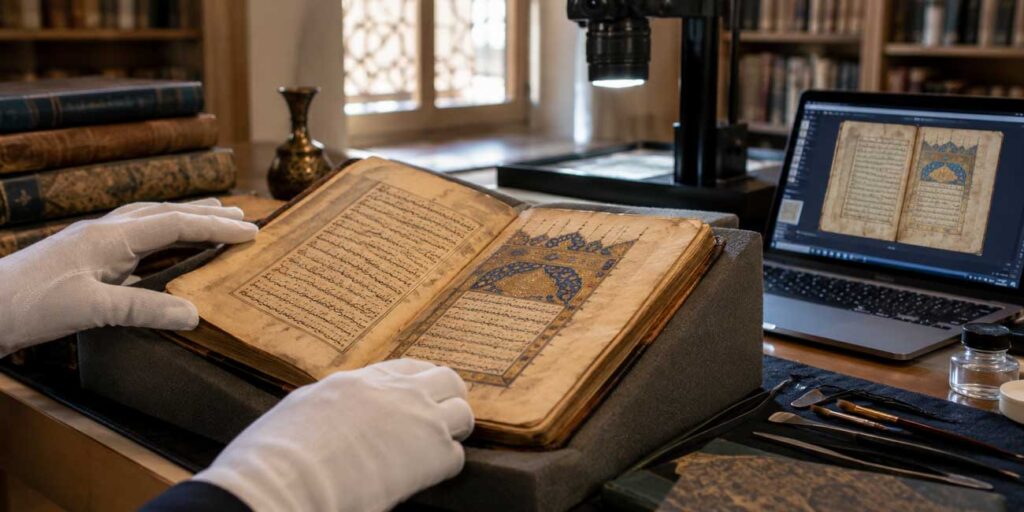
That is why manuscript preservation has become much more than putting an old book in a safe room. Today, preservation combines careful handling, appropriate storage, climate monitoring, conservation, digitisation, advanced imaging, and increasingly, artificial intelligence.
For organisations such as Manuscripts Leiden, whose work focuses on bringing important works of Islamic scholarship from manuscript form into carefully edited publications, preservation is closely connected with scholarship. The Islamic Manuscripts Press of Leiden focuses particularly on areas including premodern philosophy, Sufism, Shiʿi mysticism, Qur’anic exegesis, and Islamic theology.
But what does manuscript preservation actually involve? Why are old manuscripts so fragile? Can technology really help us recover damaged writing? And what should happen when the original manuscript cannot be safely handled?
Let’s take a closer look.
What Is Manuscript Preservation?
Manuscript preservation is the process of protecting handwritten historical documents so that their physical structure and intellectual content remain accessible for as long as possible.
This can involve several different activities:
- Safe handling
- Proper storage
- Climate and humidity control
- Protection from light
- Pest management
- Conservation treatment
- Damage assessment
- Digitisation
- Digital preservation
- High-resolution photography
- Multispectral imaging
- Cataloguing and documentation
- Scholarly editing
The key idea is simple:
Preservation is not just about saving the paper or parchment. It is about keeping the information accessible.
This distinction matters because a manuscript can survive physically while becoming difficult to read. Ink can fade. Pages can darken. Water damage can obscure writing. Earlier text can be erased and overwritten. Bindings can weaken.
Sometimes the words are still there, but our eyes can no longer see them easily.
Fortunately, modern technology is giving researchers new ways to look.
Why Are Ancient Manuscripts So Difficult to Preserve?
Manuscripts are made from organic materials, and organic materials change over time.
Depending on their age and origin, manuscripts may contain:
- Paper
- Parchment
- Leather
- Ink
- Pigments
- Gold leaf
- Adhesives
- Thread
- Wooden boards
- Other materials used in bindings or decoration
Each material reacts differently to its surroundings.
Temperature, humidity, light, pollutants, insects, microorganisms, handling, and physical stress can all contribute to deterioration.
Think of an ancient manuscript as a very old person with a complicated wardrobe.
You cannot simply throw the whole thing into one storage box and hope for the best.
The paper may want one thing.
The parchment may react differently.
The leather binding may behave differently again.
The pigments may be sensitive to light.
The conservation challenge is therefore often a balancing act.
Temperature and Humidity: The Quiet Enemies of Manuscripts
One of the most important parts of manuscript preservation is environmental control.
Temperature and relative humidity can affect paper, parchment, leather, and other organic materials.
A major study of three historic libraries in Italy examined long-term microclimate conditions and their relationship to paper deterioration. The researchers found that unfavourable temperature conditions could contribute significantly to chemical deterioration in acidic paper collections. In their modelling, some collections exposed to the measured conditions had estimated lifetimes of less than 300 years.
That number deserves some perspective.
Three hundred years sounds like an eternity when you are waiting for a pizza.
For cultural heritage, however, it is surprisingly short.
A manuscript that has already survived 500 or 800 years should ideally not be put at unnecessary risk simply because its storage environment is poorly managed.
Another study at the Alessandrina Library in Rome monitored temperature and relative humidity for two years. The library contains more than one million books dating from the 16th to the 21st centuries, and researchers identified climate-related risks including mechanical, chemical, and biological deterioration.
This is why modern manuscript preservation increasingly depends on monitoring, rather than simply setting a thermostat once and forgetting about it.
Why Humidity Fluctuations Matter
Humidity is particularly important because many manuscript materials respond to changes in moisture.
When humidity changes, organic materials can expand and contract.
Repeated changes can create mechanical stress.
Too much moisture can also encourage mould and other biological problems, while excessively dry conditions can contribute to brittleness in some materials.
The exact ideal conditions depend on the material and collection. There is no magical number that works perfectly for every manuscript everywhere.
This is one reason conservation specialists look at the actual collection, building, materials, and climate rather than applying one simplistic rule.
Research into historic libraries has also suggested that passive environmental strategies can sometimes be useful instead of immediately relying on heavy mechanical heating, cooling, and ventilation systems. A study of the Necip Paşa Library in Türkiye, for example, found that the building’s natural hygrothermal behaviour provided useful protection in some circumstances and suggested that passive solutions should receive priority where appropriate.
In other words, sometimes the smartest conservation technology is understanding the building before filling it with machines.
Light Can Slowly Damage Manuscripts
Light is another major concern.
Exposure to light can contribute to fading and chemical changes in paper, pigments, inks, and other materials.
This is why rare manuscripts are often displayed under carefully controlled lighting conditions.
The problem is particularly important for illuminated manuscripts.
Imagine spending months—or years—creating delicate decorative artwork using pigments and gold, only for uncontrolled light exposure to gradually damage it.
That would be the historical equivalent of leaving a priceless painting on the dashboard of a car.
Good manuscript preservation therefore considers:
- Light intensity
- Exposure duration
- Wavelength
- Material sensitivity
- Display conditions
Storage and exhibition strategies should be designed around the vulnerability of the particular object.
Safe Handling Is One of the Simplest Preservation Tools
Not every preservation technique requires expensive equipment.
Sometimes, it begins with clean hands and good habits.
The Library of Congress recommends careful handling of works on paper and advises keeping food and drink away from collection materials. It also warns against damaging practices such as using paper clips, rubber bands, adhesive tape, or glue on paper materials.
These rules sound almost painfully obvious.
And yet, preservation often works exactly like that.
A sophisticated conservation laboratory cannot undo every small mistake repeated over decades.
A manuscript does not need to be dramatically dropped from a helicopter to suffer damage. Repeated careless handling, pressure on bindings, unsuitable supports, or inappropriate repairs can gradually weaken a fragile object.
For researchers and visitors, simple handling procedures can therefore be surprisingly valuable.
Storage Matters More Than Many People Realise
Proper storage protects manuscripts from several risks at once.
A suitable storage system may help reduce exposure to:
- Dust
- Light
- Insects
- Humidity fluctuations
- Physical impact
- Unnecessary handling
- Pollutants
- Poor stacking
- Pressure on bindings
Housing should be appropriate to the manuscript.
A fragile parchment manuscript may require a different support from a bound paper volume.
The shape of the object matters too.
A manuscript should not be forced into a position that places unnecessary pressure on its spine, covers, pages, or binding.
In preservation, “one size fits all” is usually not a particularly helpful philosophy.
What Is Conservation?
Preservation and conservation are closely related, but they are not exactly the same thing.
Preservation generally focuses on preventing or slowing deterioration.
Conservation may involve more direct treatment of an object.
For example, conservation work may address:
- Tears
- Detached pages
- Damaged bindings
- Surface dirt
- Structural weaknesses
- Previous inappropriate repairs
- Other physical problems
The important principle is that intervention should be carefully considered.
An ancient manuscript carries evidence of its own history.
Marks, repairs, annotations, binding changes, stains, and other features may sometimes provide valuable information to researchers.
The goal is therefore not necessarily to make an ancient manuscript look brand new.
In many cases, that would actually remove part of its history.
Manuscript Preservation and Digitisation
One of the biggest changes in manuscript preservation is the growth of digitisation.
Digitisation means creating high-quality digital representations of physical manuscripts.
A digital copy can then allow researchers and the public to examine the content without repeatedly handling the original object.
This has several advantages.
A researcher in London may be able to examine a manuscript held in another country.
A student in Istanbul can study a digitised manuscript preserved in a European collection.
A scholar in North America can compare pages from several institutions without travelling to each archive.
That dramatically changes the accessibility of historical material.
Recent research on digital heritage has highlighted how digitisation is transforming the ways historical archives are accessed, organised, and researched, while also noting that digitisation creates its own questions about interpretation and representation.
Digitisation is therefore not a substitute for preservation.
It is another layer of preservation and access.
Why Digitisation Does Not Replace the Original Manuscript
It is tempting to think:
“We have a high-resolution scan, so we don’t need the original anymore.”
Not quite.
The physical object itself contains information.
Researchers can study:
- Paper or parchment structure
- Ink composition
- Binding techniques
- Sewing structures
- Pigments
- Watermarks
- Physical alterations
- Writing pressure
- Material changes
- Historical repairs
A digital image cannot always capture all of these features.
This is why physical preservation remains essential even when a manuscript has been digitised.
A scan is a powerful window into a manuscript.
It is not the manuscript itself.
Multispectral Imaging: Seeing What the Human Eye Cannot
One of the most exciting areas of modern manuscript research is multispectral imaging.
Instead of photographing an object only in ordinary visible light, researchers capture images using different parts of the electromagnetic spectrum.
This can reveal details that are difficult or impossible to see with normal photography.
For example, faded writing may become more visible under particular wavelengths.
Researchers can sometimes recover information from manuscripts that have:
- Faded ink
- Water damage
- Darkened surfaces
- Overwritten text
- Erased writing
- Multiple layers of text
A 2025 study published in The European Physical Journal Plus described the use of multispectral imaging for damaged manuscripts and palimpsests. The researchers noted that different wavelengths can help reveal different forms of degraded or obscured writing.
This is particularly important for palimpsests.
What Is a Palimpsest?
A palimpsest is a manuscript in which an earlier text was erased, scraped, washed, or otherwise removed so that the writing material could be reused.
Think of it as the medieval version of recycling paper.
Except the recycling bin contained philosophy.
Sometimes traces of the older writing remain beneath the newer text.
Modern imaging can help reveal these hidden layers without physically damaging the manuscript.
The University of Hamburg’s current research on generative AI and palimpsests describes how multispectral imaging can reveal hidden writing and how newer computational methods are being explored to help interpret these images.
This opens fascinating possibilities.
A manuscript that appears to contain one text may actually contain another story underneath it.
Artificial Intelligence Is Entering Manuscript Preservation
Artificial intelligence is becoming increasingly relevant to manuscript research.
This does not mean AI is replacing historians, conservators, or philologists.
Rather, researchers are exploring AI as a tool for processing large amounts of visual information.
One recent example is GLADUnet, a deep-learning approach published in npj Heritage Science in December 2025. The research addresses problems such as noise, texture variation, and faded writing in ancient manuscripts and explores AI-based image processing for denoising and binarisation.
Another 2025 project, AIPAD, explored a non-invasive platform combining artificial intelligence and physics for the analysis of ancient manuscripts. It brought together multispectral imaging, thermal quasi-reflectography, digital image correlation, and deep-learning methods.
This is an important development because manuscript research produces enormous amounts of image data.
AI can potentially help researchers identify patterns faster.
But there is an important warning:
AI should assist interpretation, not automatically become the final authority.
An algorithm may enhance a damaged letter, but a scholar still needs to decide whether the reconstructed reading is historically and linguistically credible.
Technology can make the detective work faster.
It does not eliminate the detective.
Digital Preservation Is More Than Taking a Photograph
There is another issue that is easy to overlook.
A digital image is itself a file.
And files can disappear.
Hard drives fail.
Servers are replaced.
File formats become obsolete.
Software changes.
Organisations close.
Passwords get lost.
So digital preservation needs its own strategy.
The European Commission’s eArchiving Initiative provides specifications, training, and guidance for preserving digital information over long periods. The initiative emphasises keeping important digital information accessible and reusable regardless of the technology used to store it.
This leads to an important principle:
Digitisation without digital preservation is only temporary protection.
A manuscript can survive for 700 years, while a poorly managed digital file can disappear in seven.
That is a slightly uncomfortable thought for anyone who has ever lost a folder called “FINAL_FINAL_NEW_VERSION2.”
Manuscript Preservation and Islamic Manuscripts
Manuscript preservation is especially important for Islamic manuscript heritage because the surviving collections cover an extraordinary range of subjects.
Islamic manuscripts include works relating to:
- Qur’anic studies
- Theology
- Philosophy
- Sufism
- Medicine
- Astronomy
- Mathematics
- Literature
- History
- Geography
- Law
- Mysticism
- Science
The Islamic Manuscripts Press of Leiden has a particular interest in premodern philosophy, Sufism, Shiʿi mysticism, Qur’anic exegesis, and Islamic theology. Its stated mission includes producing carefully edited editions of important works that survive in manuscript form.
Its current and upcoming projects include work relating to Sufism, Shiʿi studies, and Avicenna and his intellectual tradition.
This makes manuscript preservation more than a technical issue.
It becomes a question of intellectual continuity.
A manuscript preserved today can become a source for a critical edition tomorrow.
And a critical edition can make an otherwise difficult historical text available to a much wider audience.
Why Manuscript Preservation Matters for Future Generations
It is easy to think of preservation as something museums and universities worry about.
But manuscript preservation affects everyone.
The historical record we have today is already incomplete.
Countless manuscripts disappeared through:
- War
- Fire
- Flooding
- Poor storage
- Insects
- Mould
- Neglect
- Accidental destruction
- Political upheaval
- Natural disasters
- Simple passage of time
Every manuscript that survives gives researchers another piece of the puzzle.
Sometimes a single document changes our understanding of a historical figure.
Sometimes a previously unknown text reveals a forgotten intellectual tradition.
Sometimes a manuscript provides evidence about how people actually lived, studied, travelled, traded, prayed, taught, or argued.
History is rarely a perfectly assembled book.
It is more like a gigantic jigsaw puzzle with several pieces permanently missing.
Preservation prevents us from losing more pieces.
How Can Individuals Help Preserve Manuscripts?
You do not need to run a national library to care about manuscript preservation.
If you own an old family document, handwritten book, letter, religious text, or historical notebook, basic precautions can make a difference.
Keep it away from moisture
Do not store old manuscripts in damp basements or places where water leaks are possible.
Avoid direct sunlight
Long-term exposure to light can damage paper, inks, and pigments.
Handle carefully
Avoid unnecessary touching, bending, folding, or forcing a fragile binding open.
Do not use ordinary tape
Tape may cause long-term damage and can be extremely difficult to remove safely.
Avoid food and drinks
One coffee spill can create a conservation problem that lasts much longer than the coffee break.
Consider professional advice
If an object appears particularly old, fragile, valuable, or historically important, consult a qualified conservator before attempting repairs.
Digitise carefully
A high-quality digital record can provide an additional way to access the content without constantly handling the original.
But remember that the digital copy should also be stored and backed up properly.
The Future of Manuscript Preservation
The future of manuscript preservation will probably not belong to one technology.
Instead, it will combine many different approaches.
We are likely to see greater integration of:
- Artificial intelligence
- Multispectral imaging
- Machine learning
- Digital cataloguing
- Environmental monitoring
- High-resolution imaging
- Non-invasive scientific analysis
- Digital preservation systems
- Automated handwriting recognition
- International research databases
The most exciting part is that these technologies can work together.
Imagine a fragile manuscript being examined without physical intervention.
A camera captures thousands of images.
Different wavelengths reveal hidden ink.
AI helps remove visual noise.
A scholar interprets the reconstructed text.
The manuscript is digitally catalogued.
Researchers around the world can study the resulting images.
A critical edition is prepared.
And the knowledge contained in the original manuscript becomes available to a new generation.
That is manuscript preservation at its most powerful.
Manuscript Preservation: A Practical Checklist
Whether you are a collector, researcher, librarian, archivist, or simply someone who has inherited an old manuscript, consider the following checklist:
- Is the manuscript stored in a stable environment?
- Is temperature monitored?
- Is relative humidity monitored?
- Is it protected from excessive light?
- Is it protected from insects and mould?
- Is the storage housing appropriate?
- Is unnecessary handling avoided?
- Are previous repairs documented?
- Has the manuscript been photographed?
- Are high-resolution digital copies available?
- Is the digital information backed up?
- Are important files stored in more than one location?
- Is the manuscript properly catalogued?
- Has a professional conservator assessed serious physical damage?
- Can researchers access a digital copy instead of repeatedly handling the original?
The answers will not always be perfect.
Preservation is rarely about achieving perfection.
It is about reducing avoidable risks.
Manuscript Preservation Is About More Than Saving Old Books
At first glance, manuscript preservation may sound like a specialised concern for librarians, historians, museums, and collectors.
In reality, it is about something much bigger.
It is about protecting evidence of human thought.
An ancient manuscript can preserve an argument written centuries ago, a scientific observation, a poem, a theological debate, a philosophical idea, or an interpretation of a sacred text.
Its value is not determined only by its age.
Sometimes the most important manuscript is the one that answers a question nobody knew to ask.
Modern preservation methods—from carefully controlled environments to multispectral imaging and AI-assisted analysis—are giving researchers new opportunities to protect and understand these objects. Recent research has demonstrated how non-invasive imaging can reveal damaged or hidden writing, while newer AI techniques are being developed to process difficult manuscript images.
At the same time, physical preservation remains essential. Digital copies can dramatically improve access, but they cannot completely replace the original material object.
For readers interested in the study and publication of Islamic manuscript heritage, Manuscripts Leiden offers a bridge between historical manuscript scholarship and accessible published editions. The Islamic Manuscripts Press of Leiden focuses on carefully edited works in areas such as philosophy, Sufism, Shiʿi studies, Qur’anic exegesis, and Islamic theology. In the end, manuscript preservation is not simply about keeping old pages from falling apart. It is about giving future generations the chance to read, question, study, and learn from voices that might otherwise disappear.
References
- Library of Congress — Care, Handling, and Storage of Works on Paper
Library of Congress — Collections Care - European Commission — eArchiving Initiative: Preserving Digital Information
European Commission — eArchiving Initiative - European Commission — eArchiving Conformant Solutions
European Commission — eArchiving Solutions - Guo et al. (2025) — GLADUnet: Global-local attention and dynamic upsampling for ancient manuscript denoising and binarization
npj Heritage Science — GLADUnet - Multimodal Manuscript Representation: Toward an Open Repository for Manuscript Research Data (2025)
European Physical Journal Plus — Manuscript Research Data - University of Hamburg — Generative AI for Revealing Palimpsests
University of Hamburg — Generative AI and Palimpsests - AIPAD Project — Artificial Intelligence and Physics for Art Diagnostics
University of Verona — AIPAD Project - Climate-Induced Risk for the Preservation of Paper Collections: Comparative Study Among Three Historic Libraries in Italy
ScienceDirect — Climate-Induced Risk Study - Conservation Risks for Paper Collections Induced by Microclimate — Alessandrina Library, Rome
PubMed — Alessandrina Library Conservation Study - Investigation of Indoor Microclimate of Historic Libraries for Preventive Conservation of Manuscripts
ScienceDirect — Historic Library Microclimate Study - Historical Research in the Digital Age: Opportunities, Challenges, and Critical Reflections through Europeana (2025)
Journal of Integrated Information Management — Europeana Research - Manuscripts Leiden — About the Islamic Manuscripts Press of Leiden
Manuscripts Leiden — About Us - Manuscripts Leiden — Upcoming Projects
Manuscripts Leiden — Upcoming Projects