Islamic Manuscript Collections: A Global Guide to Explore
Islamic Manuscript Collections are much more than shelves filled with old books, faded ink, and pages that look as if they have been waiting patiently for several hundred years. They are records of ideas, beliefs, scientific discoveries, literature, medicine, philosophy, art, and everyday life across a huge part of the world. From Arabic Qur’anic manuscripts to beautifully illustrated Persian poetry, Ottoman histories, medical texts, philosophical works, and scientific treatises, these collections offer a remarkably detailed view of how people created, preserved, and shared knowledge long before the age of Google.
For anyone interested in Islamic history, manuscript studies, Persian and Arabic literature, the history of science, or simply beautiful old books, exploring Islamic Manuscript Collections can feel a little like opening a door into another century. And the surprising part is that you do not always need to travel to Cairo, Istanbul, Leiden, London, Cambridge, or Paris to begin. An increasing number of manuscripts and catalogues are now available online.
This growing accessibility is especially important for modern readers. A manuscript that once required a specialist, a library appointment, and perhaps a plane ticket can now sometimes be examined from a laptop. Digital collections are changing how researchers, students, historians, and curious readers interact with the written heritage of the Islamic world.
For readers interested in this field, Manuscripts Leiden offers another useful starting point. The Islamic Manuscripts Press of Leiden focuses on carefully edited editions of important works of Islamic scholarship, with particular attention to premodern philosophy, Sufism, Shi’i studies, Qur’anic exegesis, Islamic theology, and Persian and Islamic manuscript traditions. (Islamic Manuscripts Press)
What Are Islamic Manuscript Collections?
An Islamic manuscript collection is, in simple terms, a group of handwritten works connected to the intellectual, religious, literary, scientific, artistic, or social history of Muslim societies.
The word “Islamic” can sometimes make people think that every manuscript in these collections must be a religious book. That is not the case.
Islamic Manuscript Collections can contain works on subjects such as:
- Qur’anic studies
- Hadith
- Islamic law
- Theology
- Philosophy
- Sufism
- Medicine
- Mathematics
- Astronomy
- Geography
- History
- Poetry
- Literature
- Grammar and linguistics
- Calligraphy
- Art and book decoration
- Political thought
- Agriculture
- Science and technology
In other words, an Islamic manuscript collection can be much closer to a medieval university library than to a single religious archive.
The British Library, for example, describes its Arabic manuscript holdings as covering subjects ranging from Qur’anic sciences, Islamic law and mysticism to medicine, mathematics, history, geography, literature, music and other sciences. Its Arabic manuscript collection contains almost 15,000 works in about 14,000 volumes. (Qatar Digital Library)
That number alone gives a sense of the scale involved.
And then there are collections in Cambridge, Leiden, Paris, Istanbul, Tehran, Cairo, Rome, Oxford, Madrid, Berlin, and many other cities.
The map of Islamic manuscript heritage is therefore much bigger than one country or one language.
Why Are Islamic Manuscripts Important?
A printed book usually gives us information about what an author wrote.
A manuscript can give us much more.
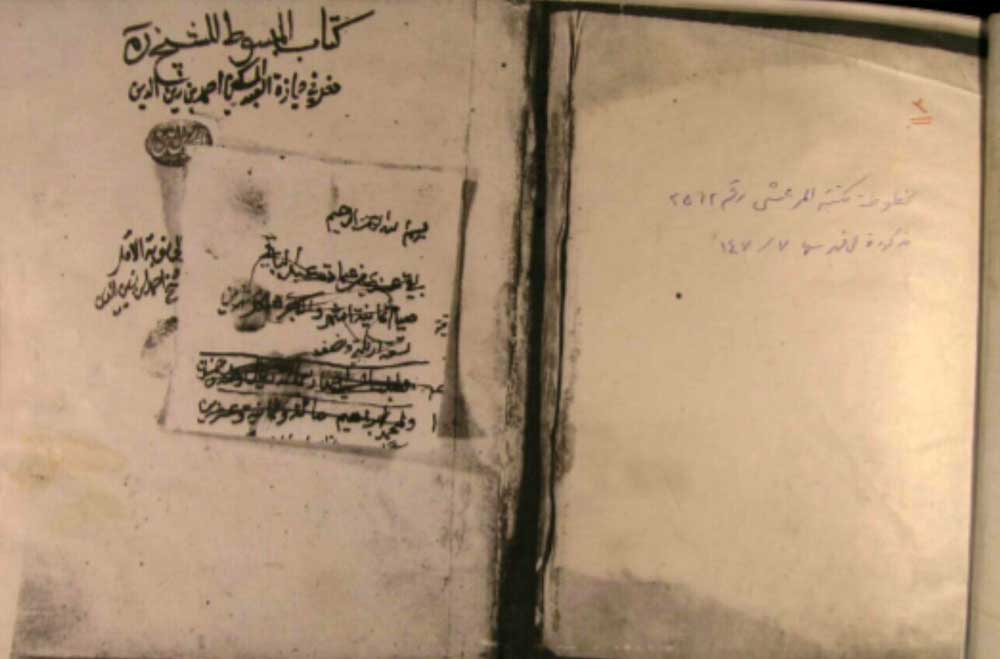
It can tell us who copied the text, where it was copied, when it was produced, who owned it, how it was used, what readers wrote in its margins, and sometimes even how it travelled from one region to another.
That makes a manuscript something like a historical fingerprint.
Imagine finding a handwritten cookbook from 700 years ago. The recipes would obviously be interesting. But the paper, handwriting, stains, annotations, ingredients, measurements, and corrections could tell you something about the people who actually used the book.
The same principle applies to Islamic manuscripts.
A medical manuscript can reveal not only medical theories but also how knowledge was organized.
A philosophical manuscript can preserve comments from generations of readers.
A Persian poetry manuscript can tell us about literary taste and artistic traditions.
A Qur’anic manuscript can provide evidence about writing styles, page design, calligraphy, and historical manuscript production.
This is why manuscript researchers do not simply “read old books.” They study the physical object as well as the words written inside it.
The Major Languages Found in Islamic Manuscript Collections
One of the most fascinating aspects of Islamic Manuscript Collections is their linguistic diversity.
Arabic is obviously central, but it is far from the only language represented.
Persian has an enormous role, especially in philosophy, poetry, literature, history, medicine, and scientific writing.
Ottoman Turkish is also important, particularly for the history of the Ottoman Empire.
Other collections include Urdu, Malay, Kurdish, and various regional languages written in Arabic-derived scripts.
Cambridge University Library provides a useful example. Its Near and Middle Eastern manuscript holdings include more than 2,500 Arabic codices, more than 1,200 Persian codices, around 450 Turkish codices, and substantial holdings in Hebrew and Syriac, along with smaller collections in other languages. (Cambridge University Library)
This diversity matters because knowledge did not travel in neat linguistic boxes.
A Persian scholar might study an Arabic philosophical text.
An Ottoman writer might copy a Persian literary work.
A European scholar might acquire an Arabic manuscript and later catalogue it in Latin or another European language.
A manuscript can therefore have a biography of its own.
Where Can You Find Islamic Manuscript Collections?
There is no single “world library” containing all Islamic manuscripts.
Instead, the material is distributed among universities, national libraries, museums, religious institutions, research foundations, private collections, archives, and digital databases.
Some of the most important collections can be found in Europe and the Middle East, but significant holdings exist elsewhere as well.
Leiden University Libraries
Leiden has a particularly important place in the history of European Islamic manuscript studies.
Leiden University Library has housed major Oriental manuscript collections for centuries, including thousands of Arabic, Persian, and Ottoman manuscripts. Leiden University has described its Oriental manuscript holdings as among the important collections of their kind in Europe. (Leiden University)
For anyone interested in the relationship between European scholarship and Islamic manuscripts, Leiden is therefore a particularly interesting case.
It is also relevant to the work of Manuscripts Leiden, whose publishing program focuses on bringing important Islamic scholarly texts into carefully edited editions. (Islamic Manuscripts Press)
Cambridge University Library
Cambridge has another major collection.
Its Islamic manuscript holdings have developed over several centuries and include Arabic, Persian, Turkish and other materials. The library also provides access to selected digitised Islamic manuscripts through its digital collections. (Cambridge University Library)
Cambridge’s collection is particularly interesting because it demonstrates how manuscript collections are not static. They grow through donations, purchases, academic projects, cataloguing, conservation, and digitisation.
The British Library
The British Library is another major destination for manuscript researchers.
Its Arabic manuscript collection contains approximately 14,000 volumes and spans many centuries and subjects. The collection includes Qur’anic manuscripts as well as works on law, theology, philosophy, science, medicine, literature and history. (Qatar Digital Library)
The library has also digitised thousands of manuscripts and archival documents, allowing people around the world to explore parts of its collections online. (British Library)
Qatar Digital Library
The Qatar Digital Library has become particularly useful for people who cannot travel to major research libraries.
The platform provides free online access to historical material relating to the Gulf and wider Middle East. It includes manuscripts, maps, archives, photographs and other materials, and it also provides access to a selection of Arabic scientific manuscripts from the British Library. (Qatar Digital Library)
This is a good example of how digitisation is changing manuscript research.
You can now study historical material from your home without touching the original object.
Of course, the original manuscript still matters enormously. A high-resolution digital image cannot completely replace examining paper, binding, texture, pigments, ink, or physical construction. But digital access dramatically expands the number of people who can begin the research process.
What Can You Learn From an Islamic Manuscript?
The obvious answer is “the text.”
But the less obvious answers are often even more interesting.
The Text
The text may preserve a work that is rare, incomplete elsewhere, or particularly important for understanding a period of intellectual history.
Sometimes a manuscript contains multiple works bound together.
Sometimes it contains a unique version.
Sometimes it preserves a text that has not yet been properly studied.
And sometimes a manuscript that appears ordinary at first becomes much more important after researchers examine it carefully.
The Handwriting
The handwriting can provide clues about date, location, training, and scribal traditions.
Different scripts developed across different periods and regions.
Kufic, Naskh, Thuluth, Nastaliq and other styles are not simply decorative handwriting choices. They can be evidence used by researchers to understand when and where a manuscript was produced.
The Paper
Paper can also tell a story.
Researchers can study its texture, thickness, fibers, watermarks, preparation, and other physical characteristics.
Paper technology played a major role in the growth of book culture across the Islamic world.
The spread of paper made the production and circulation of written knowledge easier and helped support large scholarly and literary traditions.
The Binding
The cover is not just packaging.
Historical bindings can provide evidence about artistic traditions, materials, ownership, restoration, and sometimes the movement of manuscripts between regions.
A manuscript that has been rebound several times may have had a long and complicated life.
The Margins
Perhaps one of the most entertaining parts of manuscript research is looking at marginal notes.
Modern readers write comments in the margins of books too.
The difference is that a medieval reader’s note might be hundreds of years old.
Marginalia can include corrections, explanations, references, ownership notes, questions, comments, prayers, or additional information.
Sometimes the margin is almost a second book hiding beside the first one.
The Role of Qur’anic Manuscripts
Qur’anic manuscripts occupy a special position within Islamic manuscript studies.
They are important religious objects, but they are also important historical and artistic sources.
Early Qur’anic manuscripts can help researchers study the development of Arabic writing, page organization, scripts, decoration, manuscript production, and the history of the book.
Cambridge Digital Library, for example, provides access to selected Islamic manuscripts, including early Qur’anic fragments and later beautifully illustrated Persian manuscripts. (University of Cambridge)
This demonstrates an important point: a manuscript can be studied from several angles at once.
A historian may focus on its date.
A linguist may study its language.
An art historian may study illumination.
A conservator may study the materials.
A religious studies scholar may study the text.
One manuscript can therefore support many different kinds of research.
Islamic Manuscripts and the History of Science
One of the biggest misconceptions about Islamic manuscripts is that they are primarily religious.
In reality, manuscript collections contain a huge amount of scientific material.
Islamic scholars wrote and copied works on mathematics, astronomy, medicine, geography, optics, pharmacology and other subjects.
Arabic and Persian manuscripts also played an important role in transmitting and developing knowledge from earlier Greek, Persian and Indian traditions.
This is one reason manuscript collections are important not only to Islamic history but to the wider history of global science.
The story is not simply “one civilization discovered something and another civilization copied it.”
Knowledge moved in many directions.
It was translated, criticized, corrected, expanded, reorganized, commented upon and taught.
Manuscripts are among the surviving records of that complicated process.
A Recent Reminder That Manuscripts Still Have Surprises
Even in the 21st century, old manuscripts can still generate new research.
In 2025, reports drew attention to Arabic material related to the works of the ancient Greek mathematician Apollonius preserved in the Leiden University Libraries. The material was discussed in connection with the publication Prophets, Poets, and Scholars and renewed scholarly attention to Arabic scientific manuscript traditions. (Phys.org)
The important lesson is not that every old manuscript contains a dramatic “lost book.”
It is that catalogued does not always mean fully understood.
A manuscript may have been described decades ago but later become important because of a new question, new technology, new comparison, or researcher with expertise in a particular language.
That is one of the reasons manuscript collections continue to matter.
The history of knowledge is not finished simply because the manuscript is old.
How Technology Is Changing Manuscript Research
This is where things get especially interesting.
For centuries, manuscript research depended heavily on physical access.
Today, digital technology is changing that model.
High-Resolution Imaging
High-resolution photography allows researchers to inspect tiny details without repeatedly handling fragile originals.
Researchers can zoom in on individual letters, decorations, corrections, and damaged areas.
Multispectral Imaging
Multispectral and related imaging techniques can sometimes reveal faded or difficult-to-see writing.
This can be particularly useful when ink has faded or when a later layer has obscured earlier writing.
Digital Catalogues
A digital catalogue is often just as important as the digital image.
Without good metadata, thousands of scanned pages can become a giant digital attic.
Useful catalogue information may include:
- Author
- Title
- Language
- Date
- Place of production
- Subject
- Physical dimensions
- Number of folios
- Previous owners
- Shelfmark
- Bibliographic references
Good cataloguing makes collections discoverable.
Automated Text Recognition
Artificial intelligence and machine learning are also beginning to influence manuscript research.
Historical handwriting is extremely difficult for computers because scripts change over time, letters can be written differently by different scribes, pages may be damaged, and languages may contain unfamiliar vocabulary.
Research into handwritten text recognition has shown both the potential and the limitations of automated transcription for historical Arabic-script materials. One research project on Ottoman Turkish, for example, explored deep-learning methods for transcribing texts written in Arabic script and highlighted challenges caused by script change and historical language variation. (arXiv)
This does not mean that researchers can simply scan an old manuscript and press “translate.”
Unfortunately, the button marked “Understand Everything” has not yet been invented.
Human expertise remains essential.
The Growing Scale of Digital Manuscript Databases
One of the clearest signs of change is the growth of large manuscript databases.
The Al-Furqan Islamic Heritage Foundation’s digital database is a particularly striking example. Its manuscript database currently contains around 165,000 manuscript records and draws together bibliographic information from collections connected with institutions in many countries. (Digital Library)
That is a remarkable resource for researchers.
It also illustrates the difference between a physical collection and a digital catalogue.
A digital database does not necessarily mean that every manuscript has been digitised page by page.
Often, the first step is bibliographic description.
Knowing that a manuscript exists, where it is held, what it contains, and how it is catalogued can be the beginning of serious research.
Why European Islamic Manuscript Collections Matter
Europe has accumulated significant Islamic manuscript holdings over several centuries.
The reasons are complicated.
Manuscripts entered European collections through scholarly exchange, travel, diplomatic contacts, collecting, purchases, gifts, institutional acquisitions, and other historical processes.
This history deserves careful study.
Modern researchers are increasingly interested not only in what the manuscripts say but also in how they travelled.
Who collected them?
Why were they collected?
Where did they come from?
Were they purchased, donated, exchanged, or acquired in another way?
Who catalogued them?
How were they described?
These questions can reveal another layer of history: the history of European encounters with the Islamic world.
Leiden is especially interesting in this respect because its Oriental manuscript tradition is closely connected with the development of Arabic and Islamic studies in Europe. Leiden scholars and collections have played a long-standing role in the study of Arabic, Persian and Ottoman materials. (Leiden University)
Manuscript Collections Are Not Only for Professors
You do not need a PhD to appreciate manuscripts.
A curious reader can start with a single manuscript image and ask simple questions.
What language is this?
How old might it be?
Why is the writing shaped this way?
Who might have used this book?
Why are some pages decorated?
Why are there notes in the margins?
What does the binding tell us?
These questions can lead surprisingly far.
Students can use manuscript collections for research projects.
Teachers can use digitised manuscripts in classrooms.
Families interested in cultural history can explore them together.
Artists can study historical calligraphy and illumination.
Writers can use manuscripts to better understand the intellectual worlds of earlier societies.
And historians can use them as primary sources.
The barrier to entry has never been lower.
How to Start Exploring Islamic Manuscript Collections
If you are new to the subject, do not begin by trying to understand everything.
Pick one theme.
For example:
- Qur’anic manuscripts
- Persian poetry manuscripts
- Islamic medical manuscripts
- Scientific manuscripts
- Ottoman manuscripts
- Sufi manuscripts
- Islamic philosophy
- Manuscript illumination
- Historical bindings
- Manuscript marginalia
Then choose one digital collection.
Read the catalogue description.
Look carefully at the manuscript image.
Compare it with another manuscript.
Check the date.
Check the language.
Look for scholarly references.
This simple process can teach you more than reading ten generic articles about “the history of Islamic civilization.”
For readers particularly interested in philosophy and manuscript-based scholarship, the Avicenna and His School project at Manuscripts Leiden is an interesting example of how manuscript research connects historical texts with modern critical editions. The project focuses on critical editing of works associated with Avicenna and his intellectual tradition. (Islamic Manuscripts Press)
Similarly, the Sufism projects at Manuscripts Leiden show how manuscript-based scholarship continues today, including work on important texts in theoretical Sufism and Shi’i intellectual history. (Islamic Manuscripts Press)
What Makes a Manuscript Valuable?
A manuscript’s value is not determined by age alone.
An old manuscript can be historically interesting but relatively common.
A later manuscript can sometimes be extremely valuable because it preserves a unique text, an author’s handwriting, important illustrations, or evidence about a particular historical event.
Researchers may consider several factors:
- Rarity
- Age
- Condition
- Provenance
- Author
- Content
- Language
- Historical importance
- Artistic quality
- Ownership history
- Uniqueness
- Scholarly importance
This is why judging a manuscript simply by looking at its age is risky.
“500 years old” sounds impressive.
But manuscript scholarship asks a much better question:
“What does this particular object tell us that other sources cannot?”
Preservation: Keeping Paper Alive for Another Century
Old manuscripts are fragile.
Paper can become brittle.
Ink can fade.
Leather can dry out.
Humidity can cause serious problems.
Light can damage pigments and paper.
Insects can attack organic materials.
Even frequent handling can cause gradual deterioration.
Modern conservation therefore combines traditional knowledge with scientific methods.
Libraries monitor temperature and humidity.
They use carefully designed storage systems.
Conservators repair damaged pages when necessary.
Digitisation also helps because researchers can sometimes study a digital surrogate rather than repeatedly handling the original.
But digitisation is not preservation by itself.
A digital file also needs storage, backups, metadata, migration, and long-term management.
In other words, we have gone from worrying about mice eating manuscripts to worrying about hard drives failing.
Different century, surprisingly similar problem.
The Future of Islamic Manuscript Collections
The future of Islamic Manuscript Collections will probably depend on collaboration.
No single institution owns all the answers.
Libraries have manuscripts.
Universities have scholars.
Digital platforms have technology.
Conservators have practical expertise.
Publishers and scholarly presses can turn manuscript research into accessible editions.
Projects such as Manuscripts Leiden demonstrate the value of this last step: a manuscript can be extremely important, but it becomes much more useful to readers when specialists carefully edit, explain, and publish the text. (Islamic Manuscripts Press)
The next generation of manuscript research is likely to involve even greater cooperation between historians, linguists, computer scientists, conservators, librarians, and digital-humanities specialists.
Artificial intelligence may help with transcription and discovery.
Image analysis may help researchers identify faded writing.
Linked databases may make it easier to connect manuscripts held in different countries.
Digital exhibitions may bring manuscript heritage to audiences who could never visit the original libraries.
But technology should remain a tool.
The manuscript itself remains the primary historical object.
Why Islamic Manuscript Collections Still Matter Today
It is tempting to think of manuscripts as things that belong to the past.
In reality, they keep generating new questions.
They help researchers understand how knowledge travelled.
They show how languages developed.
They preserve literary traditions.
They document religious thought.
They reveal scientific practices.
They record personal ownership and reading habits.
They demonstrate the relationship between writing and art.
And sometimes they simply remind us that people hundreds of years ago were dealing with many of the same human concerns we deal with today: learning, teaching, believing, arguing, creating, preserving, and trying to make sense of the world.
That human connection may be the most interesting thing about manuscripts.
A manuscript is old.
The curiosity it creates is not.
Summary
Islamic Manuscript Collections represent one of the world’s richest bodies of written cultural heritage. They include far more than religious texts, covering philosophy, medicine, mathematics, astronomy, literature, history, geography, art, theology, law, and many other fields.
Major collections in Leiden, Cambridge, London and elsewhere demonstrate the extraordinary geographical and linguistic diversity of Islamic manuscript heritage. Cambridge alone holds substantial Arabic, Persian and Turkish manuscript collections, while the British Library’s Arabic holdings contain roughly 14,000 volumes. Digital resources such as the Qatar Digital Library and Al-Furqan’s manuscript database are making catalogues and selected materials accessible to researchers around the world. (Qatar Digital Library)
Modern technology is adding another chapter to this story. High-resolution imaging, digital cataloguing, multispectral techniques and machine-learning-based handwriting recognition are creating new possibilities for manuscript research. At the same time, recent scholarship continues to demonstrate that even manuscripts held in major libraries for generations can produce fresh questions and new interpretations.
For readers who want to explore the intellectual and literary heritage preserved in Islamic manuscripts, Manuscripts Leiden provides a useful bridge between manuscript scholarship and accessible published editions, with a particular interest in Islamic philosophy, Sufism, Shi’i studies, Qur’anic studies and related fields. In a world where information can disappear behind a search box as quickly as it appears, preserving, studying and understanding these handwritten sources remains remarkably important.
References
- Manuscripts Leiden – About the Islamic Manuscripts Press of Leiden (Islamic Manuscripts Press)
- Leiden University – Islamic Manuscripts and the Muslim World (Leiden University)
- British Library – Arabic Manuscripts Collection (Qatar Digital Library)
- British Library – Digitised Manuscripts and Archives (British Library)
- Cambridge University Library – Islamic Manuscript Collections and Catalogues (Cambridge University Library)
- Cambridge University Library – Manuscript Collection Access and Digitised Manuscripts (Cambridge University Library)
- Qatar Digital Library – About the Digital Library (Qatar Digital Library)
- Al-Furqan Islamic Heritage Foundation – Islamic Manuscripts Database (Digital Library)
- Al-Furqan Islamic Heritage Foundation – Islamic Manuscript Collections and Records (Digital Library)
- Cambridge Repository – Islamic Manuscript Collection: Origins and Content (Cambridge University Repository)
- Google Search Central – Creating Helpful, Reliable, People-First Content (Google for Developers)
- Google Search Central – SEO Starter Guide (Google for Developers)