Rare Islamic Manuscripts: Hidden Treasures of History
Recommended URL / Slug:
/rare-islamic-manuscripts/
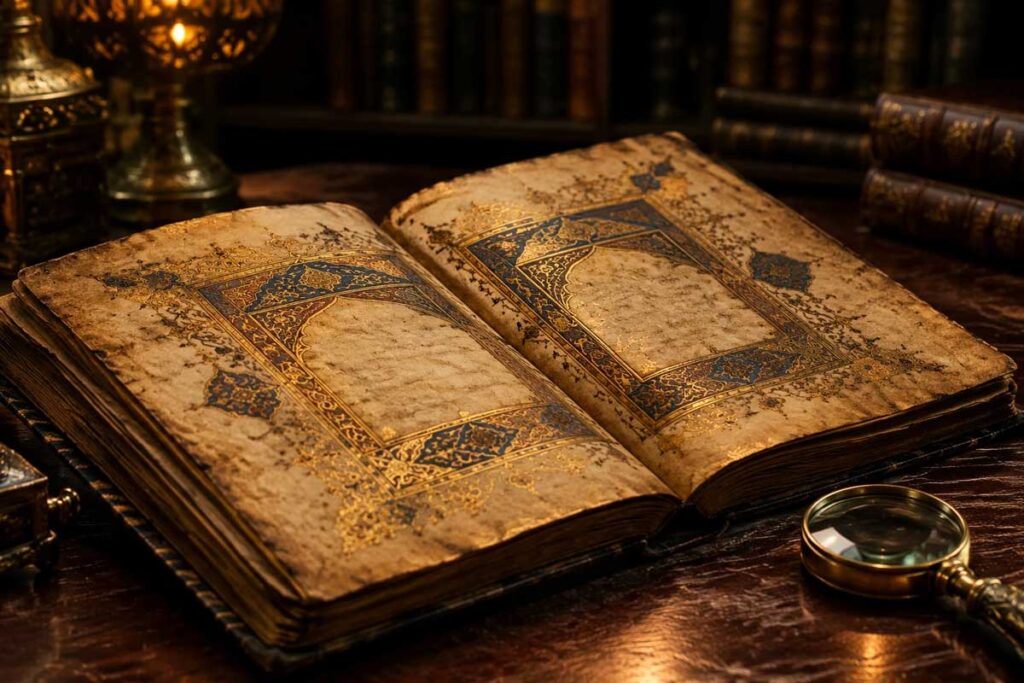
Rare Islamic manuscripts are much more than old books sitting quietly behind museum glass. They are pieces of human memory. Some preserve religious knowledge, others record medicine, astronomy, mathematics, philosophy, poetry, history, or everyday life. A few are also breathtaking works of art, filled with gold, miniature paintings, intricate calligraphy, and beautifully decorated pages.
And then there is the fascinating question of value.
How much can an ancient Islamic manuscript be worth? Why can one handwritten book sell for thousands while another can reach hundreds of thousands or even millions? What makes a manuscript rare? And perhaps most importantly, why should anyone today care about a book written hundreds of years ago?
The answers take us on a journey from Baghdad and Cairo to Persia, Central Asia, North Africa, the Ottoman world, India, Timbuktu, and the great libraries and museums of Europe and North America.
For readers interested in exploring this world further, Manuscripts Leiden offers an accessible doorway into Islamic manuscript scholarship, with a particular interest in Islamic philosophy, Sufism, Shi’i studies, Qur’anic studies, and related fields.
What Makes an Islamic Manuscript Rare?
The word “rare” sounds simple, but in the manuscript world it can mean several different things.
A manuscript may be rare because only one known copy survives. Another may be valuable because it was written by a famous scholar or calligrapher. A third may be important because it belonged to a powerful ruler.
Sometimes, the physical book itself is extraordinary.
Imagine a manuscript written on carefully prepared parchment, decorated with gold, copied in an elegant calligraphic style, and preserved for 800 years. Now imagine that it once belonged to a famous royal library.
That combination can make historians, museums, collectors, and auction houses very interested indeed.
The main factors that can influence the importance or market value of rare Islamic manuscripts include:
- Age: Older does not automatically mean better, but early manuscripts can be exceptionally important.
- Provenance: A documented ownership history can add enormous historical significance.
- Author or scribe: A manuscript associated with a famous scholar or calligrapher may be highly desirable.
- Content: Unique scientific, religious, philosophical, or literary works can be extremely important.
- Completeness: A complete manuscript is often more desirable than a single surviving fragment.
- Condition: Well-preserved pages, binding, pigments, and calligraphy matter.
- Artistic quality: Illumination, miniature paintings, calligraphy, and decoration can dramatically increase interest.
- Historical importance: A manuscript connected with a ruler, scholar, institution, or major historical event may have exceptional value.
- Rarity: If only a handful of copies are known, researchers naturally pay close attention.
So, an old manuscript is not automatically a valuable manuscript.
A 900-year-old damaged notebook with an uncertain history may be less valuable than a 500-year-old masterpiece with a documented royal provenance.
In the manuscript world, the story behind the book can be almost as important as the book itself.
A Manuscript Is More Than a Text
One of the biggest mistakes people make when looking at an ancient manuscript is to think only about the words.
A manuscript is also an object.
The paper can tell us something about trade and technology. The ink can reveal information about materials and production methods. The handwriting can help researchers identify a period or region. Marginal notes may reveal how earlier readers understood the text.
Even the binding can provide clues.
In other words, researchers do not simply ask, “What does this book say?”
They can also ask:
Who made it? Where? When? For whom? With what materials? How was it used? And how did it travel from one generation to another?
That is one reason rare Islamic manuscripts are so fascinating.
They can function simultaneously as books, artworks, historical documents, scientific objects, and cultural evidence.
The Extraordinary World of Qur’anic Manuscripts
Among the most famous rare Islamic manuscripts are early and beautifully illuminated Qur’anic manuscripts.
The history of Qur’anic manuscript production is closely connected with the development of Arabic calligraphy. Early Qur’anic manuscripts include scripts that can look very different from the Arabic writing most people see today.
The Library of Congress explains that the increasing production of Qur’ans played an important role in the development of Arabic calligraphic styles. Over time, early forms of Kufic writing were joined and eventually replaced in many contexts by more fluid scripts.
Museums around the world preserve examples from different centuries and regions.
The Metropolitan Museum of Art, for example, holds Qur’anic folios dating from the eighth or ninth century, including parchment manuscripts from the early Islamic period. One such folio uses an early form of Arabic script and lacks many of the later vowel and consonant markings that became familiar in Arabic writing.
Other Qur’anic manuscripts demonstrate how artistic traditions developed over time.
Some contain gold decoration, elaborate verse markers, illuminated headings, and carefully designed margins. A Qur’an in the Met’s collection attributed to Ottoman Turkey, for example, combines large muhaqqaq and smaller rihani scripts with geometric decoration and gilded elements.
For readers who want to explore this subject further, Manuscripts Leiden’s article on Qur’anic manuscripts provides an accessible introduction to the human and artistic story behind these texts.
The Blue Qur’an: A Manuscript That Looks Almost Unreal
Few Islamic manuscripts are as visually striking as the famous Blue Qur’an.
The manuscript is known for its deep blue or indigo parchment, gold Kufic writing, and silver decoration. It is generally dated to around the ninth or tenth century.
Recent technology has made this already remarkable manuscript even more interesting.
In 2024, researchers reported the use of multispectral imaging to reveal Qur’anic text hidden beneath a decorative layer on a page of the Blue Qur’an. The technique allows researchers to examine a manuscript under different wavelengths of light and can reveal information that ordinary photography cannot easily show.
This is a perfect example of how ancient manuscripts and modern science can work together.
The researcher brings the historical knowledge.
The technology brings another set of eyes.
And suddenly, a page that appears to show one thing may have another story underneath.
The Birmingham Qur’an and Scientific Dating
Another famous example demonstrates how scientific testing can transform our understanding of a manuscript.
The Birmingham Qur’an, held by the University of Birmingham, contains early Qur’anic parchment fragments. Radiocarbon testing conducted by the University of Oxford’s Radiocarbon Accelerator Unit produced a calibrated date range of 568–645 CE with 95.4% probability for the parchment.
There is an important scientific detail here.
Radiocarbon dating dates the animal skin used for the parchment, not directly the moment when the ink was written.
Researchers therefore combine scientific methods with paleography, codicology, historical research, and material analysis.
The Birmingham project also used multispectral imaging to investigate whether invisible writing existed underneath the visible text. The examination found no hidden underlying text and therefore indicated that the manuscript was not a palimpsest. Further XRF analysis helped identify the composition of the inks.
This is a useful reminder that dating an ancient manuscript is rarely as simple as putting it in a scientific machine and waiting for a magic number.
History is usually a team sport.
Persian Manuscripts: Where Literature Meets Art
Islamic manuscript culture was never limited to Qur’anic texts.
Persian manuscripts created an extraordinary tradition of literature, poetry, history, philosophy, science, and miniature painting.
One of the most spectacular examples is the Shahnama of Shah Tahmasp, an enormous Persian manuscript of Ferdowsi’s Book of Kings.
The Metropolitan Museum of Art describes it as arguably the most luxuriously illustrated surviving copy of the epic. The manuscript originally contained 759 folios and 258 paintings, with fine nasta’liq calligraphy and lavish decoration. It was produced in the royal workshop of Tabriz during the Safavid period.
Think about that for a moment.
This was not simply someone writing a poem into a notebook.
It was a major artistic project involving calligraphers, painters, illuminators, designers, scribes, and royal patronage.
That is why some Persian manuscripts are considered masterpieces of the history of the book.
Manuscripts from the Ottoman World
The Ottoman Empire also developed a highly sophisticated manuscript tradition.
Arabic, Persian, and Ottoman Turkish were used across different scholarly and literary contexts, and manuscripts could contain religious works, poetry, dictionaries, history, law, science, and literature.
The British Library’s manuscript catalogue contains numerous examples of Arabic, Persian, and Ottoman Turkish works. One Qur’anic manuscript, for example, contains Arabic text with an interlinear Persian translation and a later Ottoman Turkish translation.
Another remarkable example is the seven-volume Qur’an commissioned by Rukn al-Din Baybars. The British Library catalogue identifies the individual volumes and notes their commissioning certificates and colophons, as well as the illuminators involved in the project.
These details matter because they allow researchers to reconstruct not only what was written, but also how large manuscript projects were organized.
The Mughal World and Royal Libraries
Islamic manuscript culture also flourished in South Asia.
The Mughal emperors supported major artistic and intellectual projects, and royal libraries became home to extraordinary books.
A striking example appeared at Sotheby’s in 2025: a late sixteenth-century Qur’anic manuscript associated with the library of Mughal emperor Akbar. The four-volume work included Qur’anic text, Persian translation, extensive Qur’anic commentary, illuminated pages, gold decoration, and Mughal library seals and inspection inscriptions. Sotheby’s gave it an estimate of £40,000–£60,000.
This example demonstrates something important about manuscript value.
A manuscript does not need to be the oldest object in existence to be historically extraordinary.
Its ownership history can transform it.
A seal from a royal library can turn a beautiful book into a document of imperial history.
Timbuktu: A Hidden Treasure of African History
When people hear “Islamic manuscripts,” they sometimes think only of Cairo, Baghdad, Istanbul, or Tehran.
That would be a mistake.
Timbuktu in Mali was a major center of Islamic learning, and its manuscript heritage represents one of the most important written collections in West Africa.
UNESCO describes the Timbuktu manuscripts as a priceless handwritten cultural heritage preserved in both public and private collections. The organization has supported efforts to safeguard and improve access to this heritage.
These manuscripts cover a wide range of subjects.
They include religious works, but also material relating to law, science, history, literature, and everyday intellectual life.
Their importance is not merely financial.
A manuscript can be priceless even when nobody would ever put it up for auction.
That distinction is worth remembering.
What Are the World’s Most Valuable Islamic Manuscripts?
This question sounds straightforward, but there is a catch.
There is no single permanent list of “the world’s most valuable Islamic manuscripts.”
Auction records change. Some manuscripts are held permanently by museums and are never offered for sale. Others are privately owned, and their values are not public.
However, auction results can provide a glimpse into the market.
Christie’s states that it has achieved auction records in Islamic art, including a record for the most valuable Islamic manuscript sold at auction: a monumental Mamluk Qur’an copied for Sultan Qaytbay.
Other manuscripts have also achieved remarkable prices.
For example, Sotheby’s reported that a monumental Safavid Qur’an sold in 2019 for £735,000, more than three times its low estimate of £200,000.
These figures are fascinating, but they should not be misunderstood.
Auction price is not the same thing as cultural value.
A manuscript owned by a public institution may never be sold and could be impossible to price meaningfully.
In other words, some manuscripts are expensive.
Others are simply priceless.
Why Provenance Matters So Much
If you ever hear manuscript specialists talking about “provenance,” pay attention.
Provenance means the documented history of an object’s ownership and movement.
For manuscripts, this can be extremely important.
Suppose two books look almost identical.
One has no known history.
The other can be traced through a royal library, an important scholar, a famous collector, and eventually a major museum.
The second manuscript may be far more historically significant.
Provenance can also help researchers identify where a manuscript came from and how it moved across regions.
In some cases, it can help authenticate an object.
It can also raise difficult questions about cultural ownership, wartime movement, private collecting, and the modern trade in antiquities.
This is one reason reputable institutions provide detailed catalogue records whenever possible.
How Technology Is Changing Manuscript Research
The study of rare Islamic manuscripts is no longer limited to magnifying glasses, notebooks, and extremely patient scholars.
Modern technology is opening new doors.
Multispectral Imaging
Multispectral imaging photographs a manuscript using different wavelengths of light.
Some inks, pigments, stains, or erased texts respond differently under different wavelengths.
This can help researchers:
- reveal faded writing
- identify erased text
- examine damaged areas
- distinguish pigments
- study changes to a manuscript
- investigate possible palimpsests
The Blue Qur’an and Birmingham Qur’an demonstrate how powerful these methods can be.
Research published in npj Heritage Science in 2025 also explored spectral methods and machine-learning approaches for identifying materials in historical documents. Such work can support the study of inks and writing supports without relying only on invasive testing.
Artificial Intelligence and Handwriting Recognition
Another rapidly developing area is handwritten text recognition.
Historical Arabic manuscripts are particularly challenging because Arabic writing is connected, highly variable, and represented in many calligraphic styles.
A 2025 systematic review examined deep-learning approaches to handwritten text recognition in historical Arabic manuscripts and highlighted both the progress and the continuing challenges of working with damaged documents and different scripts.
AI can potentially help researchers search large collections more efficiently.
But there is an important warning.
AI should not automatically be treated as an infallible manuscript expert.
A machine can misread handwriting, misunderstand abbreviations, confuse similar characters, or invent a plausible-looking answer.
Human scholars still matter.
Very much.
Recent research evaluating AI systems for Islamic manuscripts has itself emphasized the need to examine accuracy and completeness rather than assuming that an AI-generated interpretation is automatically correct.
The future is therefore likely to involve cooperation between technology and human expertise rather than one replacing the other.
Why Digital Manuscript Collections Matter
Imagine having access to a manuscript that is physically located thousands of kilometres away.
A century ago, that might have required a long journey.
Today, digitization can sometimes bring the manuscript to your screen.
Cambridge University Library, for example, holds more than 2,500 Arabic codices, more than 1,200 Persian codices, and around 450 Turkish manuscripts within its Near and Middle Eastern collections. Selected Islamic manuscripts are also available through the Cambridge Digital Library.
The Library of Congress also provides online access to digitized manuscript materials, including a Qur’an with Persian translation containing hundreds of digitized images.
Digitization does not replace the physical manuscript.
A digital image cannot reproduce every aspect of paper texture, binding, smell, weight, or three-dimensional construction.
But it can dramatically expand access.
For students, researchers, teachers, and curious readers, that is a huge development.
The Role of Manuscripts Leiden
This is where organizations focused specifically on Islamic manuscripts become especially useful.
Manuscripts Leiden describes itself as the Islamic Manuscripts Press of Leiden and focuses on producing carefully edited editions of important works of Islamic scholarship. Its areas of interest include premodern philosophy, Sufism, Shi’i mysticism, Qur’anic exegesis, and Islamic theology.
The value of this kind of work is easy to underestimate.
Finding an old manuscript is one thing.
Understanding it is another.
A manuscript may contain difficult handwriting, unusual vocabulary, damaged passages, multiple copies of the same work, marginal notes, corrections, or textual variations.
Scholars may compare several surviving manuscripts to establish a more reliable version of a text.
This process can take years.
Sometimes much longer.
Manuscripts Leiden’s publishing projects, including its work connected with Avicenna and other areas of Islamic intellectual history, reflect this broader goal of bringing manuscript-based scholarship into a form that can be studied by modern readers and researchers.
Readers can also explore Manuscripts Leiden’s publications and its wider Islamic manuscript resources and articles to continue learning.
Why Rare Islamic Manuscripts Still Matter Today
It is tempting to think that manuscripts belong entirely to the past.
They do not.
They still influence modern scholarship.
A manuscript can change our understanding of how an idea developed. It can reveal a previously unknown author. It can preserve an earlier version of a text. It can show how people in another period understood medicine, astronomy, philosophy, theology, literature, or law.
It can even challenge a modern assumption.
And sometimes, the most exciting discovery is not a spectacular golden page.
It may be a tiny handwritten note in the margin.
Someone hundreds of years ago may have written a comment, correction, translation, ownership note, or personal observation.
That small sentence can suddenly make the manuscript feel less like an archaeological object and more like a conversation across centuries.
Are Rare Islamic Manuscripts Only About Religion?
Absolutely not.
Religion is an important part of Islamic manuscript heritage, but the collection is far broader.
Islamic manuscripts can include:
- Philosophy
- Medicine
- Astronomy
- Mathematics
- Geography
- Poetry
- History
- Literature
- Law
- Theology
- Linguistics
- Mysticism
- Political thought
- Scientific observation
Cambridge’s collections, for example, cover Arabic, Persian, Turkish and other languages and include a wide range of subjects.
The British Library’s Oriental manuscript collections similarly demonstrate the extraordinary variety of texts produced across centuries.
This diversity is one reason the term “Islamic manuscript” should not be understood as meaning simply “old Qur’an.”
It describes a much larger intellectual world.
What Can a Manuscript Teach Us About Everyday People?
Perhaps one of the most charming aspects of manuscript research is that it can reveal ordinary human behavior.
People made mistakes.
They corrected them.
They wrote notes.
They added comments.
They signed their names.
They recorded ownership.
They sometimes doodled.
They complained about things.
They passed books from one person to another.
In other words, manuscripts are not only records of famous scholars and kings.
They also contain traces of readers.
That makes them valuable sources for social history.
A manuscript can tell us not only what educated people were expected to know, but also how knowledge was actually used.
Preserving These Treasures for the Future
Rare manuscripts are fragile.
Paper can become brittle. Parchment can react to humidity. Pigments can fade. Leather can deteriorate. Inks can corrode the writing surface. Poor storage conditions can accelerate damage.
Climate control, careful handling, conservation science, digitization, and professional cataloguing therefore play major roles in preservation.
UNESCO’s work with the manuscripts of Timbuktu is a good example of why preservation cannot be separated from cultural heritage protection. The organization has emphasized both safeguarding the physical collections and improving access to them.
Modern conservation can also use scientific techniques to understand materials without damaging them.
Research on Iranian Qur’anic manuscripts, for example, has used non-invasive imaging and spectroscopy to investigate historical pigments and their distribution.
The goal is not simply to make an old book look pretty.
It is to keep the evidence alive.
The Future of Rare Islamic Manuscripts
The next chapter of manuscript history may be surprisingly high-tech.
Researchers are combining:
- High-resolution photography
- Multispectral imaging
- Hyperspectral analysis
- Digital catalogues
- Optical and handwritten text recognition
- Machine learning
- Artificial intelligence
- Digital humanities
- Online manuscript libraries
Recent research is even exploring AI-supported platforms that allow scholars to annotate and investigate manuscripts collaboratively.
At the same time, technology has limits.
A computer may identify a pattern, but understanding why that pattern matters can require years of historical knowledge.
A machine can recognize letters, but context can determine what those letters actually mean.
And an algorithm can process thousands of pages quickly, while a specialist may notice one tiny marginal note that changes the interpretation of an entire work.
The most exciting future may therefore be a partnership.
Human curiosity plus machine speed.
Historical expertise plus scientific imaging.
Old ink plus new technology.
That sounds like a pretty good team.
Final Thoughts: Why These Hidden Treasures Deserve Our Attention
Rare Islamic manuscripts are among the world’s most fascinating cultural treasures because they combine knowledge, art, history, religion, science, and human experience in a single physical object. From early Qur’anic parchment and magnificent Persian illustrated books to Ottoman scholarly works and the extraordinary manuscript heritage of Timbuktu, these works show how widely knowledge travelled and how carefully generations preserved it. Their value cannot be measured only by auction prices: some are worth thousands or millions in the art market, while others are culturally priceless because they preserve unique evidence about human history. New technologies such as multispectral imaging, scientific material analysis, digitization, and AI-assisted handwriting recognition are now helping researchers discover information that previous generations could not easily see. For anyone who wants to explore this remarkable world further, Manuscripts Leiden provides a valuable gateway to Islamic manuscript scholarship and carefully edited works of Islamic intellectual history. Its focus on subjects such as philosophy, Sufism, Shi’i studies, Qur’anic studies, and theology helps connect the surviving manuscripts of the past with readers and researchers of the present.
Sources and Further Reading
- The Islamic Manuscripts Press of Leiden – About Us — Information about Manuscripts Leiden, its mission, and research areas.
- Manuscripts Leiden – Islamic Manuscript Collections — Accessible overview of major Islamic manuscript collections and modern manuscript research.
- University of Birmingham – Birmingham Qur’an: Research and Conservation — Radiocarbon dating, multispectral imaging, and scientific analysis of the Birmingham Qur’an.
- The Metropolitan Museum of Art – Qur’an Manuscript — Example of an Ottoman Qur’anic manuscript with calligraphy and illumination.
- The Metropolitan Museum of Art – Folio from a Qur’an Manuscript — Early Qur’anic parchment dating to the eighth or ninth century.
- The Metropolitan Museum of Art – The Shahnama of Shah Tahmasp — Information on one of the most lavishly illustrated Persian manuscripts.
- Cambridge University Library – Manuscript Collections & Catalogues — Details of Cambridge’s Arabic, Persian, Turkish and other Near and Middle Eastern manuscript collections.
- British Library – Oriental Manuscripts Catalogue — Catalogue records for Arabic, Persian and Ottoman Turkish manuscripts.
- UNESCO – Timbuktu Manuscripts — Information about preservation and access to Timbuktu’s manuscript heritage.
- Christie’s – Islamic and Indian Art — Information on Islamic manuscript auctions and auction records.
- Sotheby’s – A Lost Masterpiece in Blue & Gold — Details of a Safavid Qur’an that sold for £735,000 in 2019.
- Sotheby’s – Qur’an Manuscript from the Library of Akbar — Example of a Mughal manuscript associated with Akbar’s library.
- Nature – Spectral Unmixing in Historical Manuscripts — 2025 research on spectral analysis and machine learning for manuscript material identification.
- Engineering, Technology & Applied Science Research – Deep Learning for Historical Arabic Manuscripts — 2025 systematic review of handwritten Arabic manuscript recognition.
Rare Islamic Manuscripts